IN THIS CHAPTER
"Venture and private markets" is a broad idea. The easiest way to make sense of it is to follow the money.
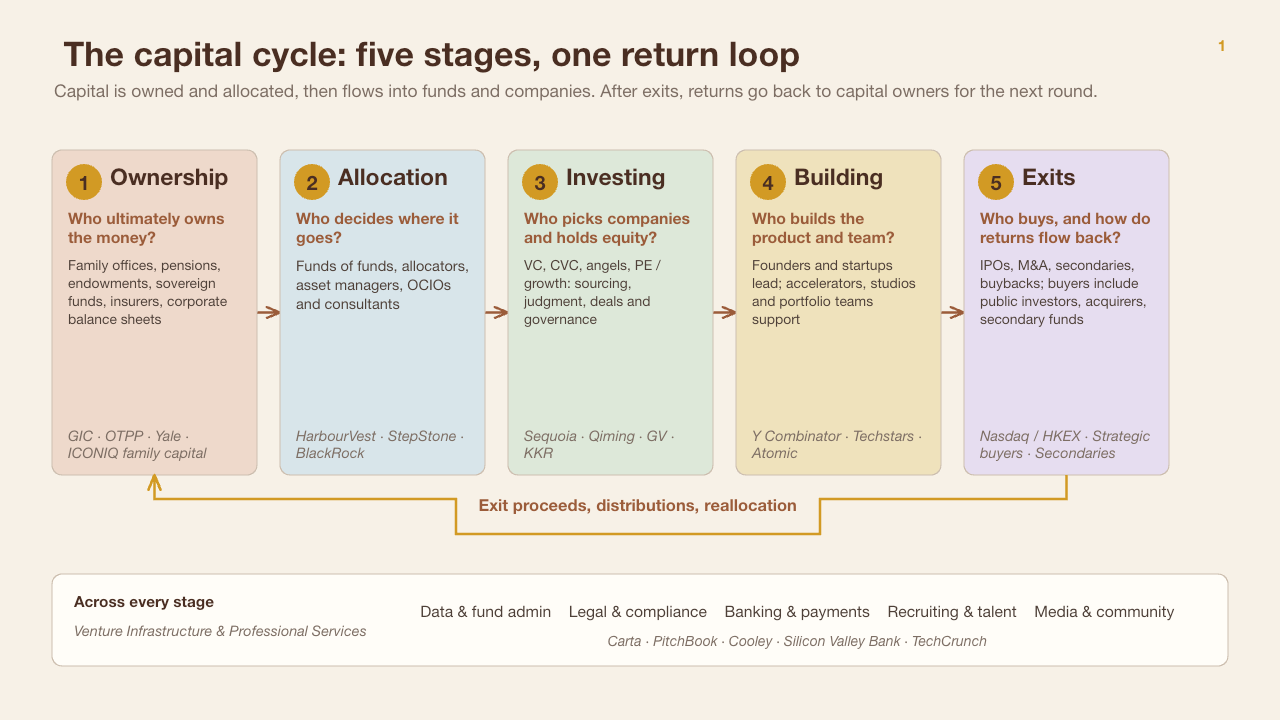
Who provides venture capital?
The money behind venture funds usually starts with limited partners, or LPs: pension funds, university endowments, foundations, insurers, sovereign investors, family offices and other institutions. They commit capital to funds managed by general partners, or GPs. Some capital owners also invest directly in companies.
How money moves from LPs to funds and startups
Money travels from capital owners to companies along four common routes. Intermediaries aren't fixed gates: to read any route, ask who owns the capital, who allocates it and who invests directly.
- Two layers: capital owner → fund of funds or asset manager → VC / PE fund → company. Many pension funds and insurers work this way, handing fund selection to specialists.
- One layer: the capital owner invests directly as an LP in VC or PE funds, which then invest in companies. University endowments, sovereign wealth funds and large family offices commonly do this.
- Direct: family offices, sovereign funds or high-net-worth individuals take stakes in companies themselves. In Silicon Valley, I regularly come across family offices and wealthy individuals investing directly in leading AI companies.
- Corporate capital: a parent company funds its corporate venture arm from its own balance sheet, and the CVC invests in startups.
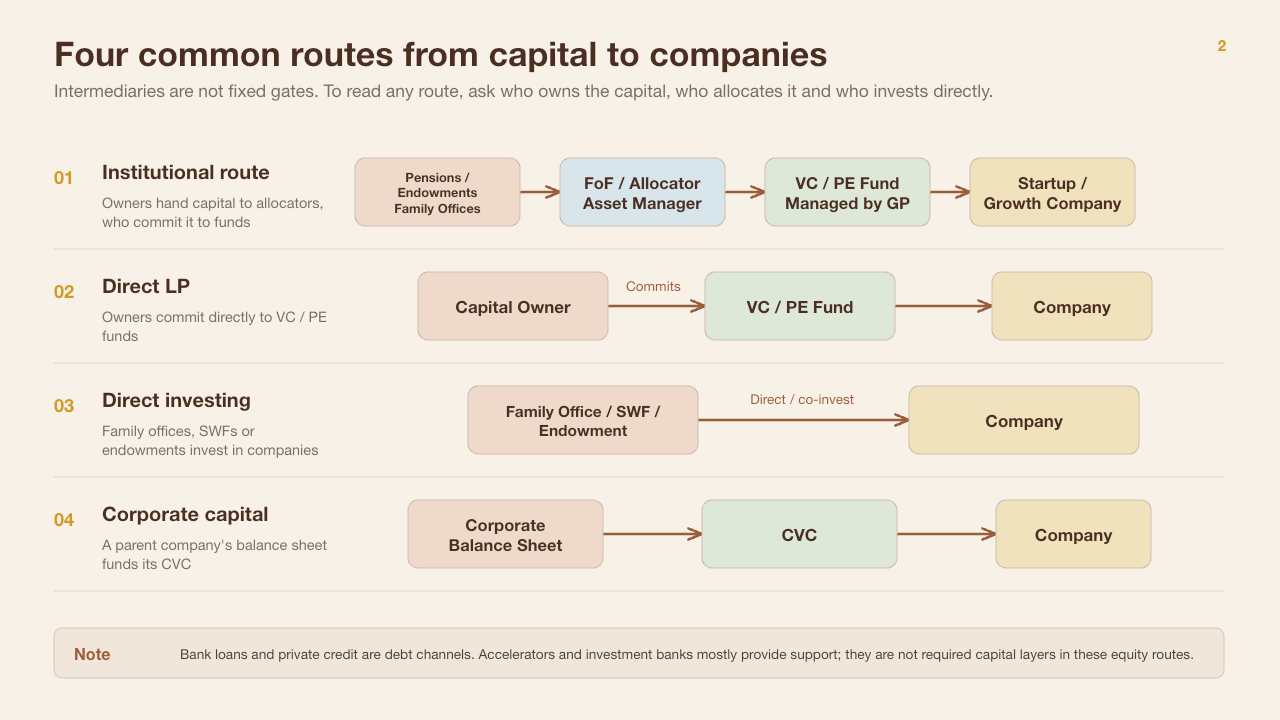
Bank loans and private credit are debt channels, and accelerators and investment banks mostly provide support; none of them is a required capital layer in these equity routes.
How venture capital returns flow back to investors
When a portfolio company is acquired, goes public or distributes proceeds through another liquidity event, money flows back to the fund. The GP returns capital and profits to LPs after fees and carried interest. The cycle then begins again as LPs decide which managers and strategies deserve new commitments.
How capital owners, asset managers and VC funds differ
The question I use most to tell these organizations apart is: is it managing its own balance sheet, or money entrusted by clients and LPs? Temasek is a state-owned investment company that invests its own balance sheet, while a family office invests a family's capital. Fidelity and J.P. Morgan Asset Management primarily manage money for clients. A VC fund is managed by a GP on behalf of LPs. The distinction sounds small, but it shapes an organization's pace, style, accountability, pay and promotion structure.
Once you understand this chain, the eight employer types are easy to follow. Each one simply sits at a different point along it.
Write your answer to the exercise before moving on. A plan only counts once it becomes evidence.