IN THIS CHAPTER
Between a venture capital resume and an offer sit two filters: assessments, then interviews. The exact process varies by firm, but the underlying questions are consistent: can you form a point of view, defend it with evidence and contribute to this team's work?
Venture capital written tests and take-home assessments
Large financial institutions often use a test before interviews. Smaller venture firms are more likely to use a take-home assignment during the interview process.
- Large banks and financial institutions: aptitude tests covering logic, numeracy, verbal reasoning and sometimes English or subject knowledge.
- International banks and asset managers: numerical reasoning, situational judgment and one-way video interviews such as HireVue.
- Private equity: modeling tests, often a simplified LBO model and an investment recommendation produced under time pressure.
- Venture capital and accelerators: a company analysis, market map, sourcing exercise, investment memo or short presentation.
Candidates often lose points here because they begin preparing too late. Practice the exact format before recruiting begins. Modeling needs repetition; timed video responses need rehearsal; investment assignments need a clear framework.
Venture capital interview process, round by round
A common VC interview process looks like this:
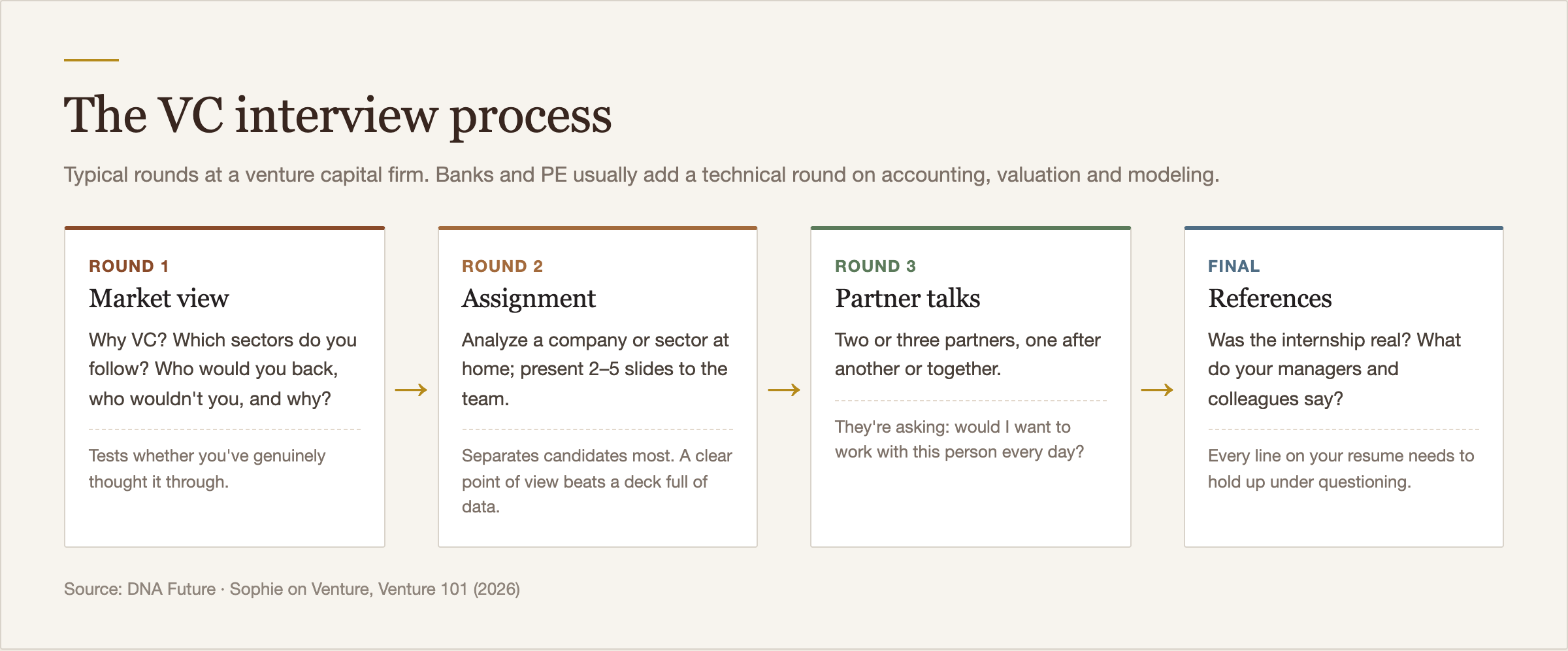
Round 1: motivation, market view and firm fit. Expect questions such as: Why venture capital? Why this fund? Which sectors do you follow? Which portfolio company interests you? Which company would you back, and which would you pass on?
Round 2: case study or assignment. You may analyze a company or market, prepare two to five slides, write an investment memo or present a sourcing strategy. A clear recommendation and honest assessment of risk matter more than a deck filled with data.
Round 3: partner interviews. Two or three partners may interview you separately or together. At this stage, they are testing judgment, communication and whether they want to work with you every day.
Final round: reference checks. Firms verify whether the experience on your resume is real, how you worked and what former managers and colleagues say about you. Every line of your application must withstand follow-up questions.
Common venture capital interview questions
Prepare answers in six groups.
Motivation and fit
- Why venture capital rather than banking, consulting, product or a startup?
- Why this fund, stage, sector and geography?
- What would you contribute during your first three months?
A weak answer says innovation is exciting. A strong answer connects the firm's actual work with evidence from your background.
Market and investment judgment
- Which market are you most excited about, and why now?
- Which startup would you invest in?
- What would make you pass on that company?
- What evidence would change your mind?
Build one market thesis before the interview. Know the customer, budget owner, market structure, competitors, timing and biggest risks.
Firm and portfolio knowledge
- Which portfolio company do you find most interesting?
- Which investment would you have questioned?
- What does the portfolio reveal about the firm's thesis?
- Which firms compete for the same deals?
Don't repeat the firm's About page. Show a pattern you found and a question it raises.
Sourcing and networks
- How would you find companies before other investors?
- Which founder communities or technical networks can you access?
- Tell us about a company or person you identified before others did.
The point isn't to claim a huge network. It is to show a repeatable method for finding relevant people and companies.
Technical and fund questions
- How do venture capital funds make money?
- What are LPs, GPs, management fees and carried interest?
- What is dilution, and why does ownership matter?
- How would you evaluate an early-stage company with little revenue?
Use Chapter 1 to review the capital cycle before the interview.
Behavioral questions
- Tell me about a time you changed your mind.
- How have you made a decision with incomplete information?
- When did you disagree with a team and what happened?
- What is the strongest criticism someone could make of your judgment?
Venture is full of uncertainty. Interviewers are looking for intellectual honesty, not artificial certainty.
How to prepare for a venture capital case study
Use a simple investment structure:
- Company: what it does, for whom and why now.
- Problem: how painful and frequent the problem is.
- Market: customer, budget, size, growth and timing.
- Product: why the solution is meaningfully better.
- Distribution: how the company acquires customers.
- Traction: revenue, usage, retention, pilots or other evidence.
- Team: founder-market fit and execution ability.
- Risks: the strongest reasons the investment could fail.
- Recommendation: invest, pass or collect more evidence, and why.
You don't need perfect information. You need a defensible recommendation and a clear account of what you don't yet know.
Write your answer to the exercise before moving on. A plan only counts once it becomes evidence.