IN THIS CHAPTER
- Step 1: Choose the kind of venture employer you want to join
- Step 2: Choose a job function, not just an industry
- Step 3: Pick a sector where you can develop an unfair advantage
- Step 4: Build proof before you ask for the role
- Step 5: Build relationships before a job opens
- Step 6: Apply with a role-specific resume
- Step 7: Prepare to make an investment judgment
Most people start a venture capital job search with the wrong question: "Which famous funds are hiring?" A better question is: "Which employer, function and sector would value the proof I already have?"
Breaking into venture isn't one application process. A seed VC, a growth fund, a corporate venture team, a family office and a portfolio-operations group are hiring for different work. The path becomes much clearer when you take seven steps in order.
Step 1: Choose the kind of venture employer you want to join
Start with the eight employer types in Chapter 2. Don't apply to all of them with the same story.
- Early-stage VC values sourcing, founder judgment, product sense and a strong view of an emerging market.
- Growth VC and PE place more weight on financial analysis, diligence, deal execution and commercial evidence.
- CVC values industry knowledge and the ability to connect investments with the parent company's strategy.
- Family offices and capital owners often value discretion, long-term judgment, manager selection and relationship skills.
- Accelerators and venture studios prioritize execution, founder support and comfort with zero-to-one work.
Your first output should be a target list of no more than two employer types. "Venture capital" is too broad to be a useful job-search target.
Step 2: Choose a job function, not just an industry
Investing is only one of the seven functions in Chapter 3. A candidate who says "I want to work in VC" has not yet made a career decision. A candidate who says "I want to do healthcare research at an early-stage fund" has.
Choose the work you want to be accountable for:
- finding and evaluating companies;
- researching markets and technology;
- helping portfolio companies recruit, sell or operate;
- raising funds and managing LP relationships;
- running finance, legal and fund operations;
- building data, product and technical systems;
- growing a firm's brand and community.
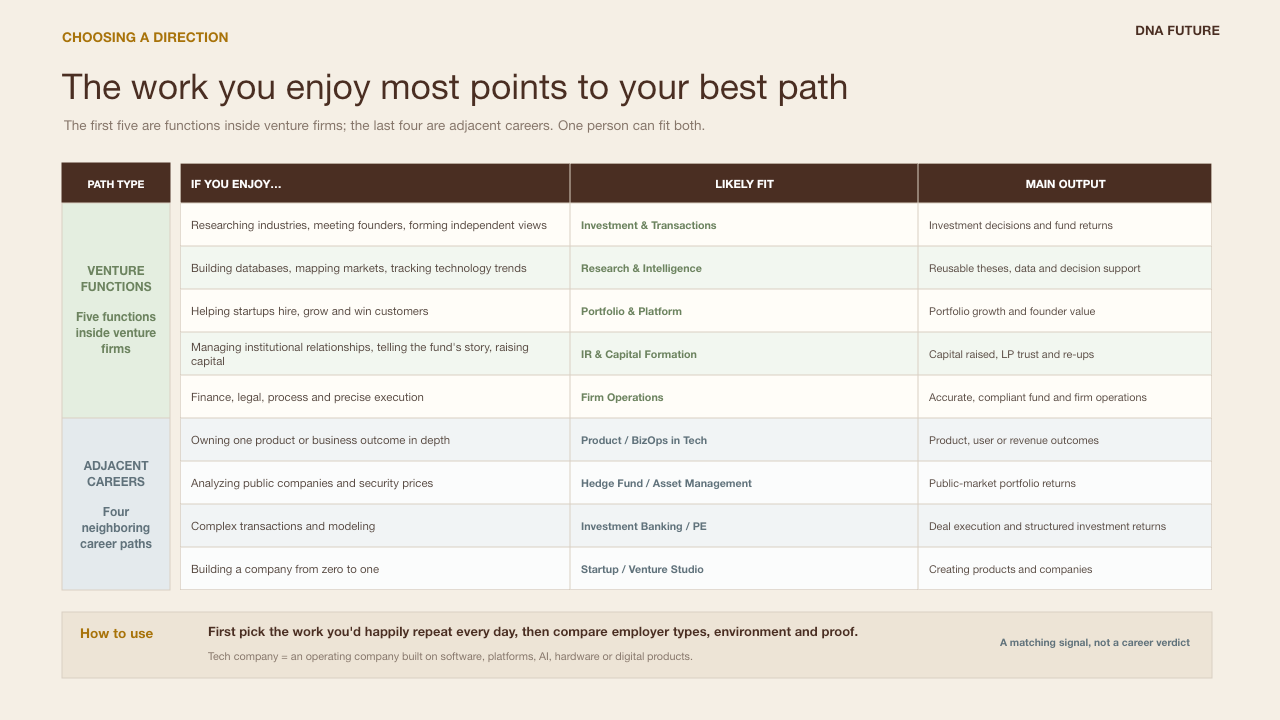
The function determines the evidence your application needs. If you're not sure which one fits, start from the work you would happily repeat every day. Some of those answers point to functions inside venture firms; others point to neighboring careers that can lead into venture later.
Step 3: Pick a sector where you can develop an unfair advantage
General curiosity is useful once you have the job. It is rarely enough to win the job.
Pick one or two sectors where your background gives you a credible starting point: AI infrastructure, healthcare, fintech, climate, consumer, robotics, semiconductors or another domain you can study deeply. Then build a view on what is changing, why now and which companies matter.
An engineer may have an advantage in technical diligence. A healthcare PhD may understand scientific risk. A product manager may see distribution and user behavior more clearly. A student can still build an edge through sustained research and direct work with founders.
Step 4: Build proof before you ask for the role
"Strong interest in venture capital" isn't proof. Employers need evidence that you can already perform part of the job.
Useful proof includes:
- an investment memo with a clear recommendation;
- a market map that identifies companies, customers and white space;
- a startup you sourced and introduced to an investor;
- measurable work for a founder or portfolio company;
- a technical or commercial diligence project;
- a public body of research that shows consistent judgment.
The goal isn't to imitate a full-time investor. It is to make your ability visible before someone takes the risk of hiring you.
Step 5: Build relationships before a job opens
Large institutions have structured recruiting cycles. Small funds often hire only when a need appears, and the role may be filled before it is widely posted.
Follow target firms, partners and junior team members. Read their investment theses and recent deals. When you reach out, bring a specific observation, relevant research or a company that fits the fund, not a generic request to "learn about VC."
The best networking creates evidence of fit. A thoughtful memo sent three months before a role opens can be more valuable than another last-minute application.
Step 6: Apply with a role-specific resume
Your resume should answer one question in its first few lines: why are you useful for this role?
An early-stage VC resume should foreground sourcing, startups, products and market judgment. A growth or PE resume should foreground modeling, diligence and transactions. A portfolio role should show operating results. An IR role should show clients, fundraising and communication.
Chapter 6 explains how to translate your experience into role-specific proof.
Step 7: Prepare to make an investment judgment
VC interviews rarely stop at behavioral questions. You may be asked which market you follow, which startup you would back, what would make you pass, or how you would source companies for the fund. Many firms also use a written memo, market map or short case presentation.
Prepare one market thesis, one company you would invest in and one company you would pass on. Be ready to explain the evidence, the risks and what would change your mind. Chapter 7 covers the interview process round by round.
If you don't yet have finance, startup or investment experience, the process is the same, but the proof you build and the route you choose will be. Chapter 8 covers the alternative paths for students, engineers, PhDs, operators and career changers.
Write your answer to the exercise before moving on. A plan only counts once it becomes evidence.