IN THIS CHAPTER
- Choose an entry route that matches your background
- Can you get into venture capital without a finance degree?
- How can an engineer or PhD get into venture capital?
- How can students build experience before their first VC job?
- Build proof when you do not have the title
- Which employers accept transferable experience?
- A 30-day plan to enter venture without experience
You can get into venture capital without previous VC experience. You can't get in without relevant proof.
The practical question isn't "How do I make my background look like finance?" It is "Which venture role already values what I know, and what evidence would make that value visible?"
Choose an entry route that matches your background
| Your background | Functions to prioritize | Employers and routes to prioritize |
|---|---|---|
| Finance, accounting | Investment and transactions; fund operations | PE, investment banks, asset managers, growth VC |
| STEM, engineering, PhD | Research; technical diligence; deep-tech investing; product and data | Deep-tech VC, healthcare VC, CVC, asset-management research, technical fellowships |
| Product or Big Tech | CVC investing; portfolio operations; product and data | CVC, VC platform teams, accelerators |
| Consulting, operations, Fortune 500 | Portfolio operations; strategy; founder support | PE and VC portfolio teams, accelerators, venture studios |
| Wealth management, trusts, insurance, sales | Investor relations; fundraising; client relations | Family offices, asset managers, private banks, PE and VC IR teams |
| Humanities, media, marketing, community | Marketing and community; research; investor communications | VC platform teams, asset managers, banks, ecosystem services |
| Founder or early startup employee | Investment; sourcing; portfolio support | Early-stage VC, accelerators, venture studios |
Your background sets the starting point. It doesn't decide the ceiling.
Can you get into venture capital without a finance degree?
Yes. Your degree isn't the main barrier; your talent stack is.
STEM graduates can move into research, technical diligence and deep-tech investing. Product and engineering backgrounds fit CVC, portfolio operations and technology roles. Humanities, media and marketing backgrounds can fit community, content and investor relations. Operators can help portfolio companies recruit, sell and scale.
The trade-off is that non-finance candidates still need to learn the basic language of funds, ownership, valuation and returns. You don't need to pretend to be an investment banker, but you must understand how the firm makes decisions and money.
How can an engineer or PhD get into venture capital?
The most direct routes are research, technical diligence and deep-tech investing. Healthcare, biology, materials, quantum, semiconductors and AI all need people who can judge whether the technology is real.
Technical expertise alone isn't enough. You also need to translate the technology into market, regulatory, supply-chain and commercialization logic. A strong technical candidate can answer both questions:
- Does the technology work, and what makes it defensible?
- Who needs it, who pays, and what must happen before adoption?
Technical fellowships, sector research, work with university spinouts and CVC teams can all provide an entry point. Another route is a bank industry group or an asset manager's research team, where depth is also valued.
How can students build experience before their first VC job?
Students should not wait for someone to grant them the title "investor." Start by doing a small version of the work:
- write an investment memo on one startup;
- map a market and identify the companies that matter;
- help a student founder interview customers or prepare fundraising materials;
- organize a focused founder or investor community;
- join a scout, fellowship or student-fund program;
- work at a startup or accelerator close to the sector you want to understand.
The goal is to move from Level 1 proof (interest) to Level 2 proof: work that someone can inspect.
Build proof when you do not have the title
Employers ask the same question of every unconventional candidate: why should we believe you can do this job?
I use three levels of proof:
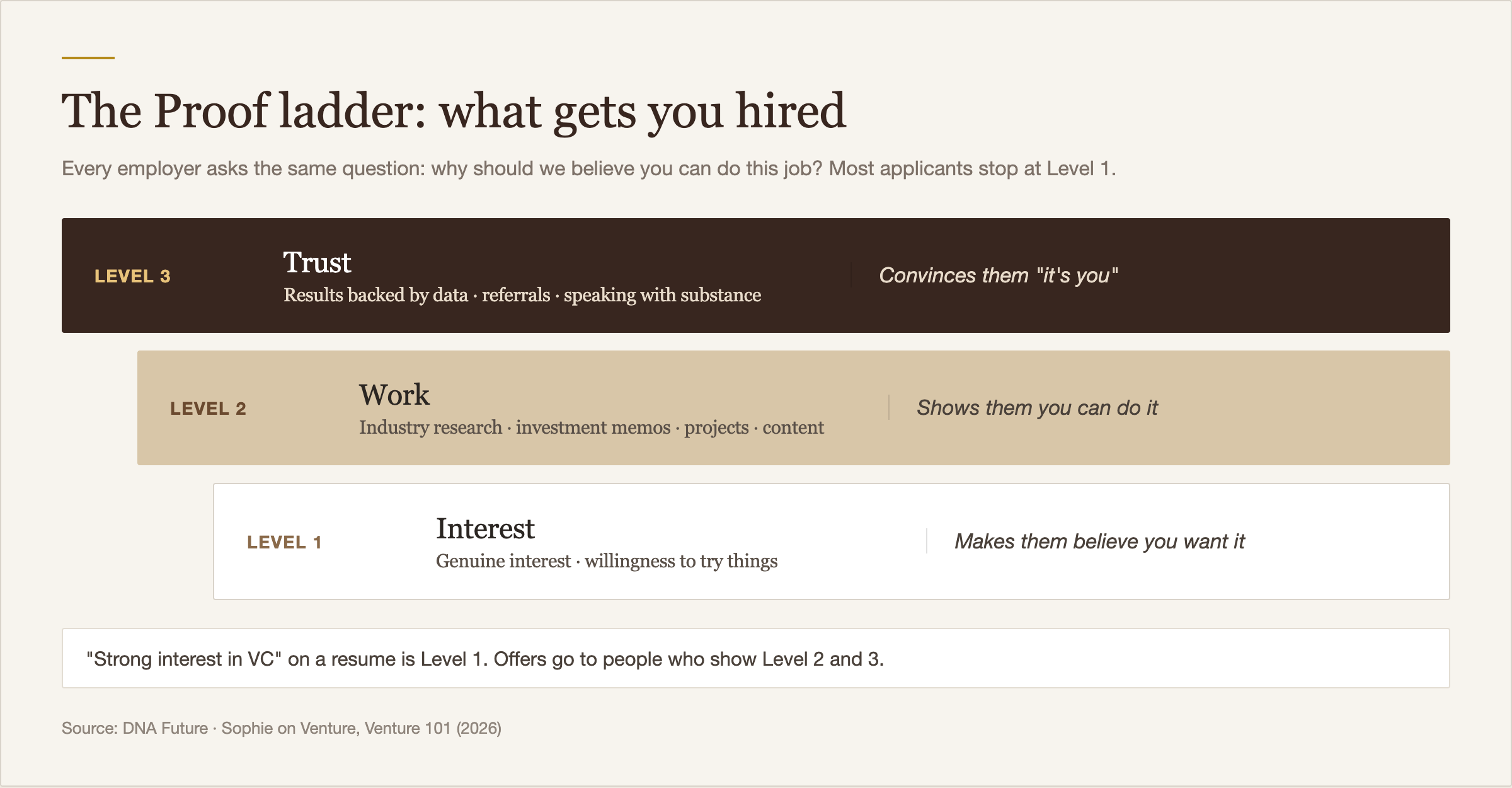
- Level 1: interest. Courses, clubs, events and statements such as "strong interest in VC." These show motivation but don't prove ability.
- Level 2: visible work. Investment memos, market maps, technical research, startup projects, published analysis and measurable operating results.
- Level 3: earned trust. A founder, investor, professor or employer is willing to recommend you because your work created value.
Most applicants stop at Level 1. Without formal experience, your job is to reach Level 2 quickly and Level 3 deliberately.
Which employers accept transferable experience?
Different employers accept different substitutes for direct VC experience:
- Early-stage VC and accelerators: startup work, product judgment, sourcing and founder networks.
- Growth VC and PE: banking, consulting, modeling, commercial diligence and transaction experience.
- CVC: product, strategy, engineering or business experience in the parent company's industry.
- Portfolio operations: recruiting, sales, growth, partnerships and operating results.
- Investor relations: fundraising, wealth management, client service and communication.
- Research and technical roles: advanced domain knowledge, publications and the ability to explain commercial implications.
If you're coming from a tech company, the closest role you already hold usually maps to one venture function. The table below shows what transfers directly, what venture adds and what proof to build.
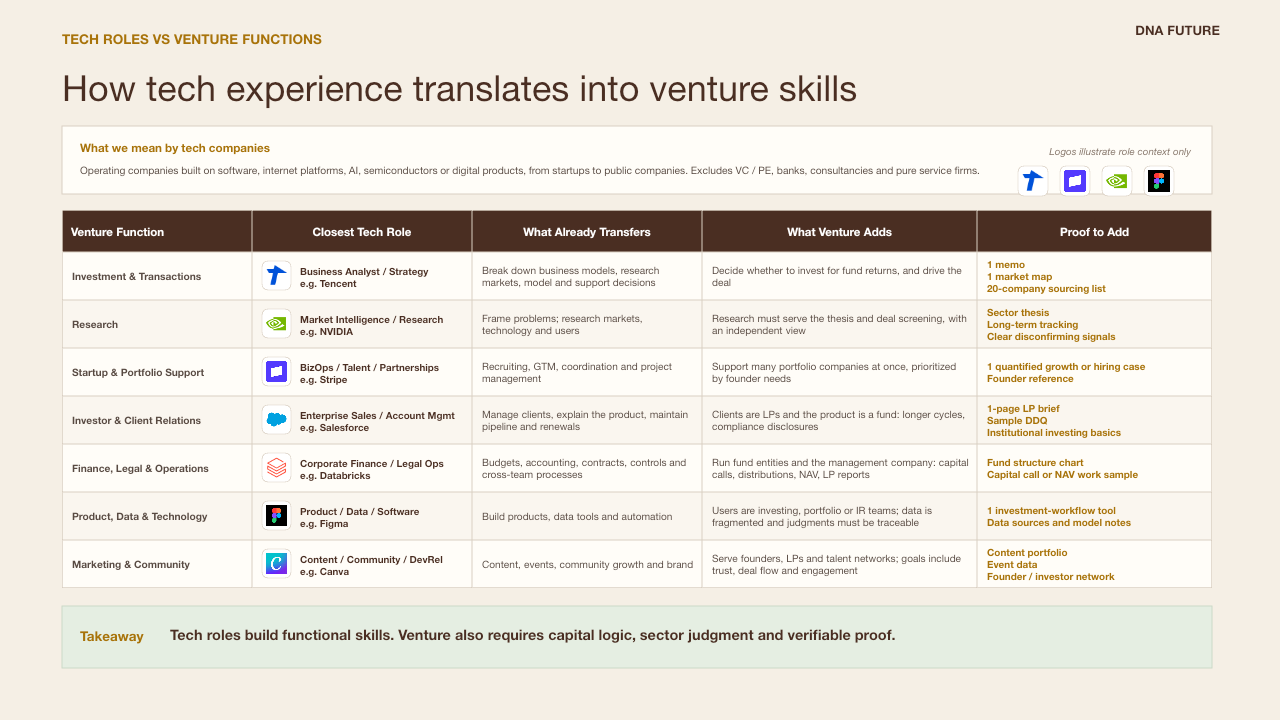
The more senior the role, the more transferable skills and sector judgment matter. Employers stop asking whether you held the exact title and start asking whether your track record proves the required abilities.
A 30-day plan to enter venture without experience
Week 1: choose one employer type, one function and one sector. Read ten relevant job descriptions.
Week 2: create one piece of proof: a market map, investment memo, technical landscape or portfolio-company project.
Week 3: speak with five people doing the target job. Ask about their work, not for an immediate referral.
Week 4: revise the proof using their feedback, publish or package it, then approach a focused list of firms.
If you are still studying, Chapter 5 covers internships and recruiting timelines. If you are ready to apply, use Chapter 6 and Chapter 7.
Write your answer to the exercise before moving on. A plan only counts once it becomes evidence.