IN THIS CHAPTER
- What top VC teams look like: LinkedIn data from a16z, Sequoia and GV
- 1. Venture capital investment roles: sourcing, diligence and deals
- 2. Venture capital research jobs: markets, technology and investment theses
- 3. VC portfolio operations jobs: helping portfolio companies grow
- 4. Investor relations in venture capital: fundraising and LP relations
- 5. Venture fund operations: finance, legal and compliance
- 6. Product, data and technology jobs at venture and financial firms
- 7. Marketing and community roles at venture and financial firms
After reading about the eight employers, most students and job seekers react the same way: "I'd love to work at all of them. But what would I actually do?"
Start with a map. Grouped by what each job is accountable for, the jobs in venture form three work systems:
| Work system | Functions | Core result |
|---|---|---|
| Capital formation and investment | Fundraising, LP & client relations; investment & transactions | Bring capital in, and put it to work |
| Research and value creation | Research; portfolio & startup support | Better judgment and more valuable portfolio companies |
| Operations and ecosystem | Finance, legal & operations; product, data & technology; marketing & community | An efficient, compliant firm with growing influence |
There is no hierarchy between the three systems; they are accountable for different results. Capital formation and investment raises capital and deploys it. Research and value creation improves the quality of judgment and the value of portfolio companies. Operations and ecosystem keeps the firm efficient and compliant and extends its reach. Different firms also classify IR, portfolio, platform and research roles differently. And marketing and community roles at financial institutions, done well, put you in front of the most influential people in the industry.
Here's where each function shows up (● common, ○ less common):
| Function | Capital owners | Asset mgmt | VC | CVC | PE | Accelerators | Banks | Ecosystem |
|---|---|---|---|---|---|---|---|---|
| Investment & transactions | ● | ● | ● | ● | ● | ○ | ● | ○ |
| Research | ● | ● | ● | ● | ○ | ○ | ● | ● |
| Portfolio & startup support | ○ | ○ | ● | ● | ● | ● | ○ | ○ |
| Fundraising, LP & client relations | ● | ● | ● | ● | ● | ○ | ● | ● |
| Finance, legal & operations | ● | ● | ● | ● | ● | ● | ● | ● |
| Product, data & technology | ○ | ● | ○ | ○ | ● | ○ | ● | ● |
| Marketing & community | ○ | ● | ● | ○ | ○ | ● | ● | ● |
The pattern is obvious: investing is just one of seven functions, while finance, legal and operations, and fundraising and client relations, are needed almost everywhere. If you only target investment roles, you miss most of the opportunities.
What top VC teams look like: LinkedIn data from a16z, Sequoia and GV
Still, the same function carries different weight at different firms. When I screen resumes and interview candidates, I see one misconception again and again: stereotyping these roles. Even among top firms, the people they hire are very different. I compared the public LinkedIn profiles of people at a16z, Sequoia and GV, looking at both job functions and fields of study, and found two things.
View 1 — Team composition: the three firms have different talent stacks
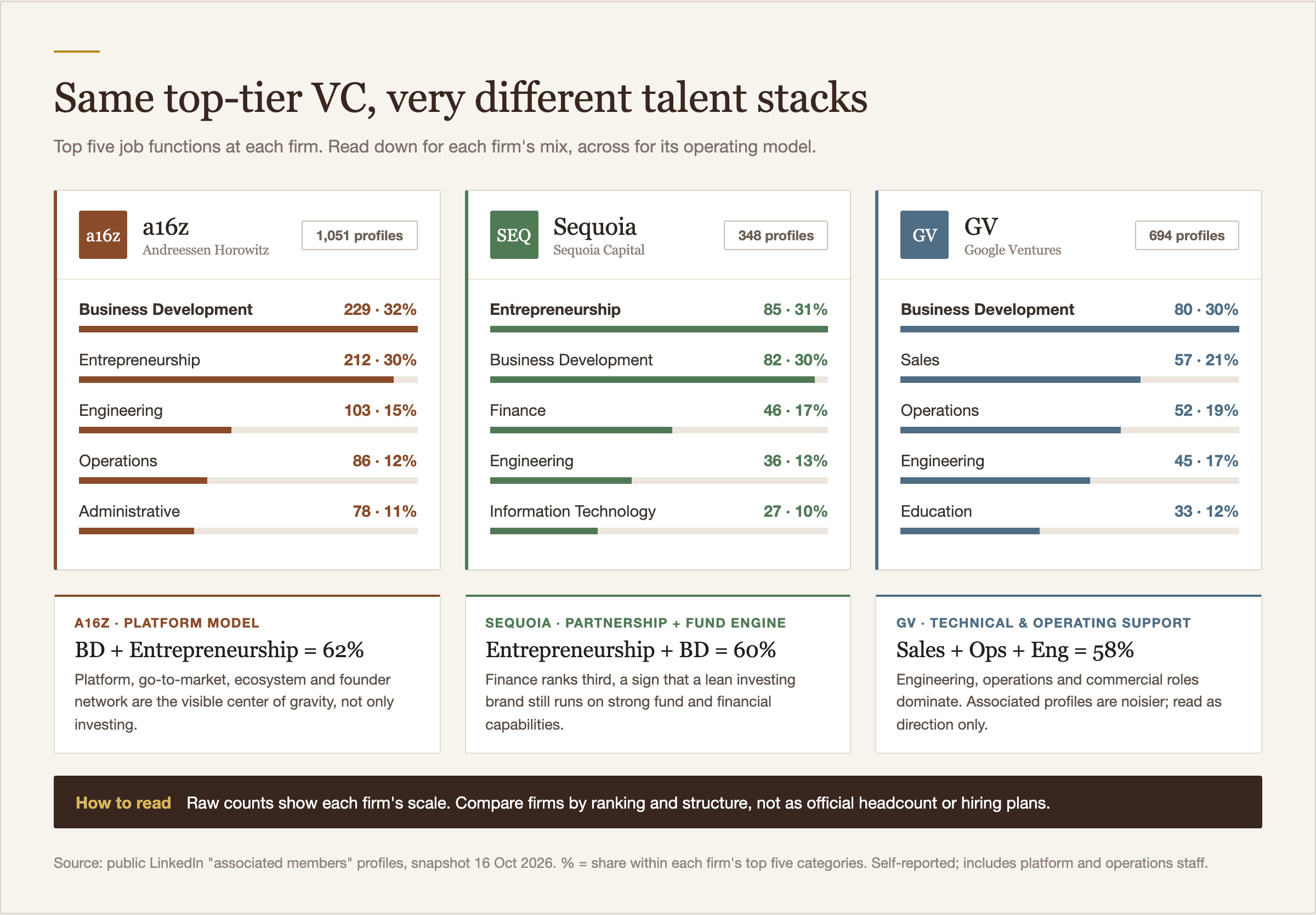
- a16z: Business development 32%, entrepreneurship 30%, engineering 15%. It looks more like a platform serving founders, with many people working on ecosystem connections and portfolio support.
- Sequoia: Entrepreneurship (31%) and business development (30%) lead, and finance (17%) appears in the top five only here. This may reflect Sequoia's coverage from early stage through growth: the later you invest, the more financial analysis matters.
- GV: Business development (30%), sales (21%) and operations (19%) lead, and entrepreneurship doesn't make the top five. GV is funded by Alphabet but makes investment decisions with relative independence, which makes it closer to a professional VC backed by corporate capital than a strategic arm serving the parent's business. The high share of sales, operations and engineering backgrounds describes the team's make-up; it doesn't tell us GV's investment objectives.
View 2 — Academic background: finance is not the only route into VC
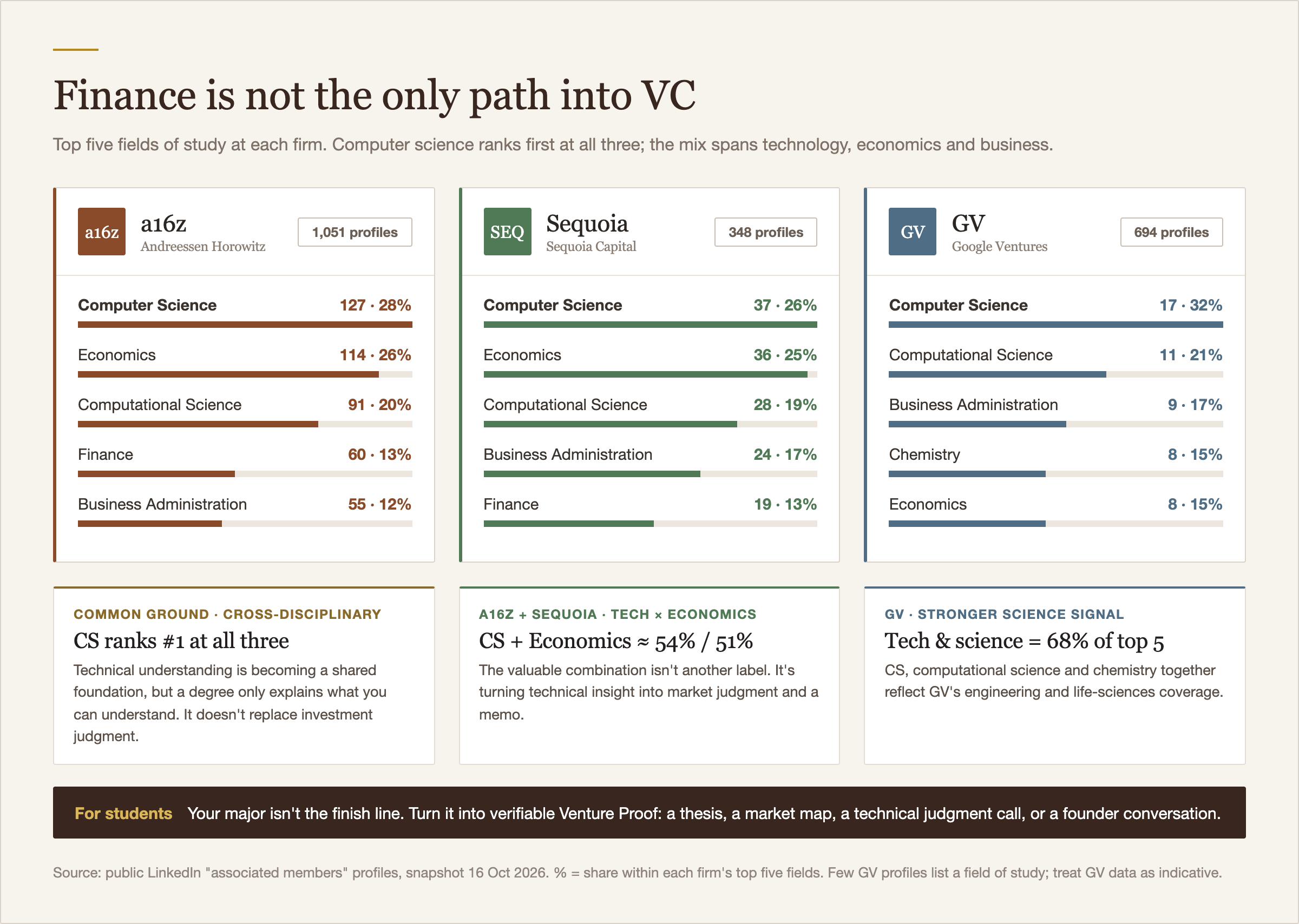
- Computer science ranks first among the top five fields in all three public samples (a16z 28%, Sequoia 26%, GV 32%). Technical understanding has become a common foundation in VC.
- a16z and Sequoia are "tech + economics": computer science and economics together account for 54% and 51%.
- GV leans scientific: computer science, computational science and chemistry together account for 68%, matching its focus on life sciences and deep tech.
- Finance is not the largest background: at least in these three public samples, finance is 13% at a16z and Sequoia, and outside the top five at GV.
So before you apply, look at who is on the team. The closer your skills are to the firm's talent stack, the easier it is to get noticed. And your degree isn't the finish line. Whether you studied computer science, economics, chemistry or anything else, what matters is turning it into visible Venture Proof: an investment thesis, a market map, or a technical judgment call.
Data note: Snapshot of public LinkedIn profiles listed as associated members on each company page, taken 16 October 2026. Percentages are each category's share within the firm's top five functions or fields of study, not a share of all employees. Profiles are self-reported and include platform and operations staff, so they show broad tendencies only. Relatively few GV profiles list a field of study, so treat GV's education data as indicative.
1. Venture capital investment roles: sourcing, diligence and deals
Investment roles are the core of venture, but two jobs both called "investment" can involve completely different work.
Day to day: sourcing deals, screening, industry research and due diligence, building financial models, writing investment memos, and taking part in investment decisions and negotiations.
Accountable for: backing good companies, avoiding bad ones, and ultimately the fund's returns.
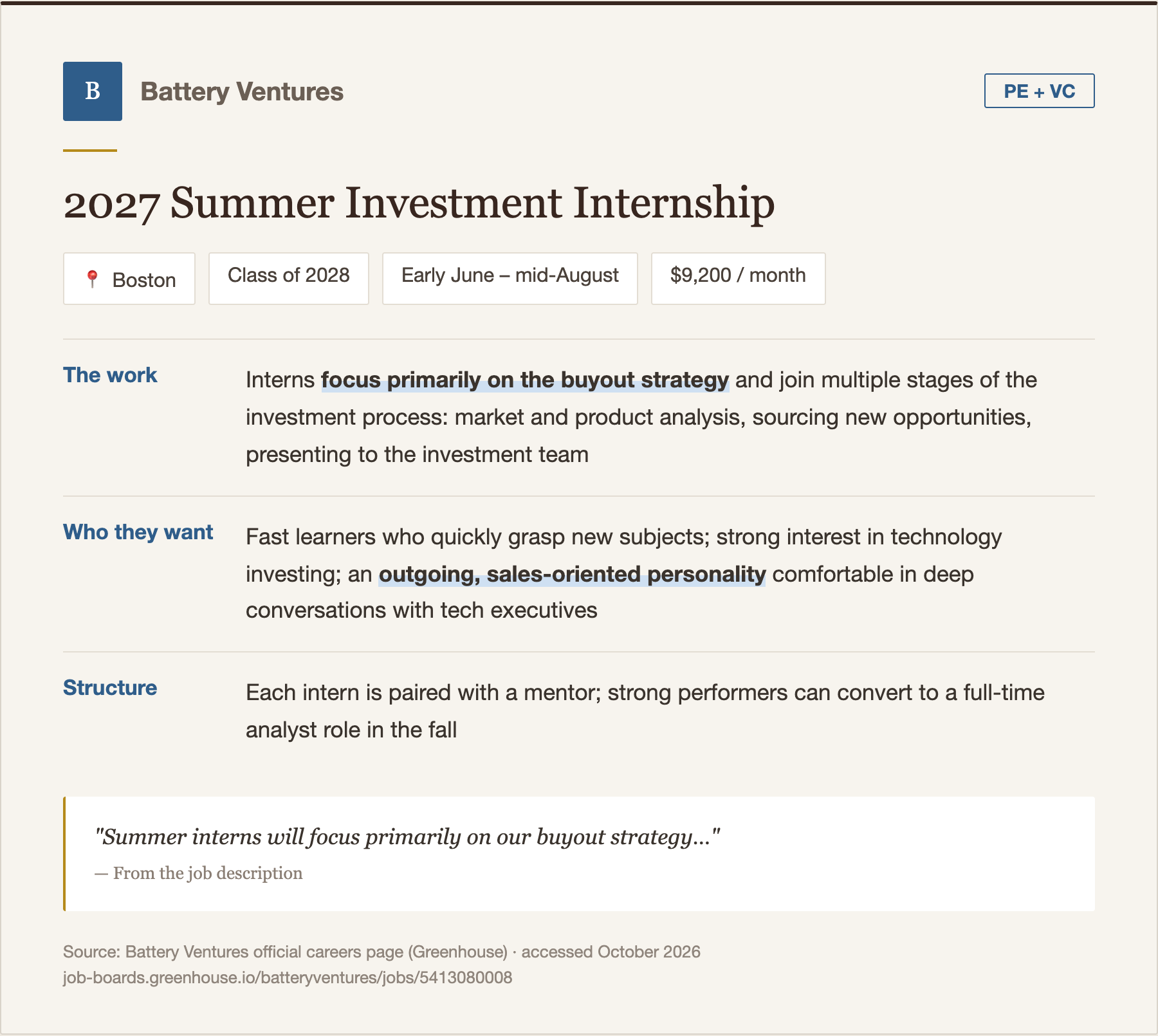
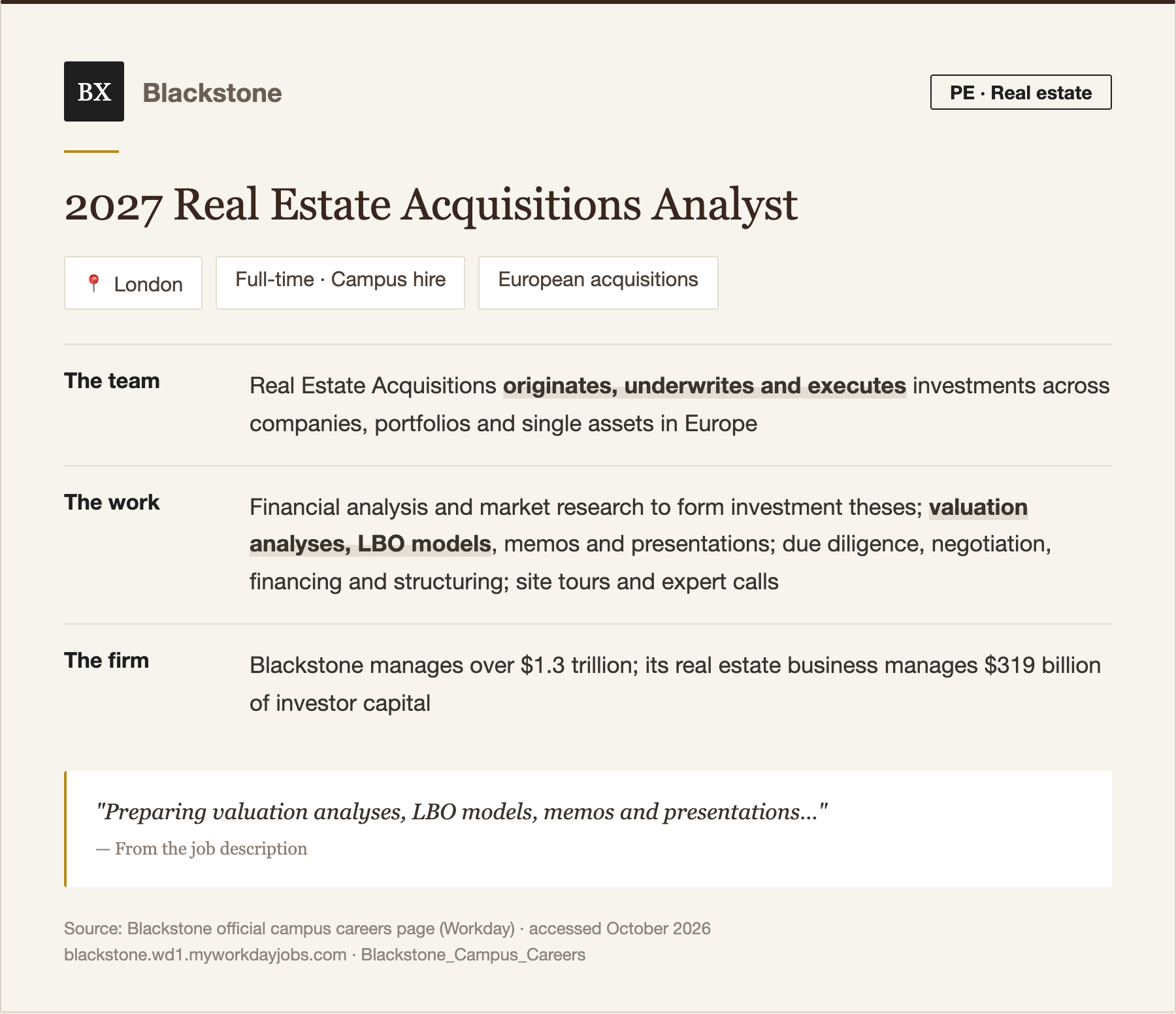
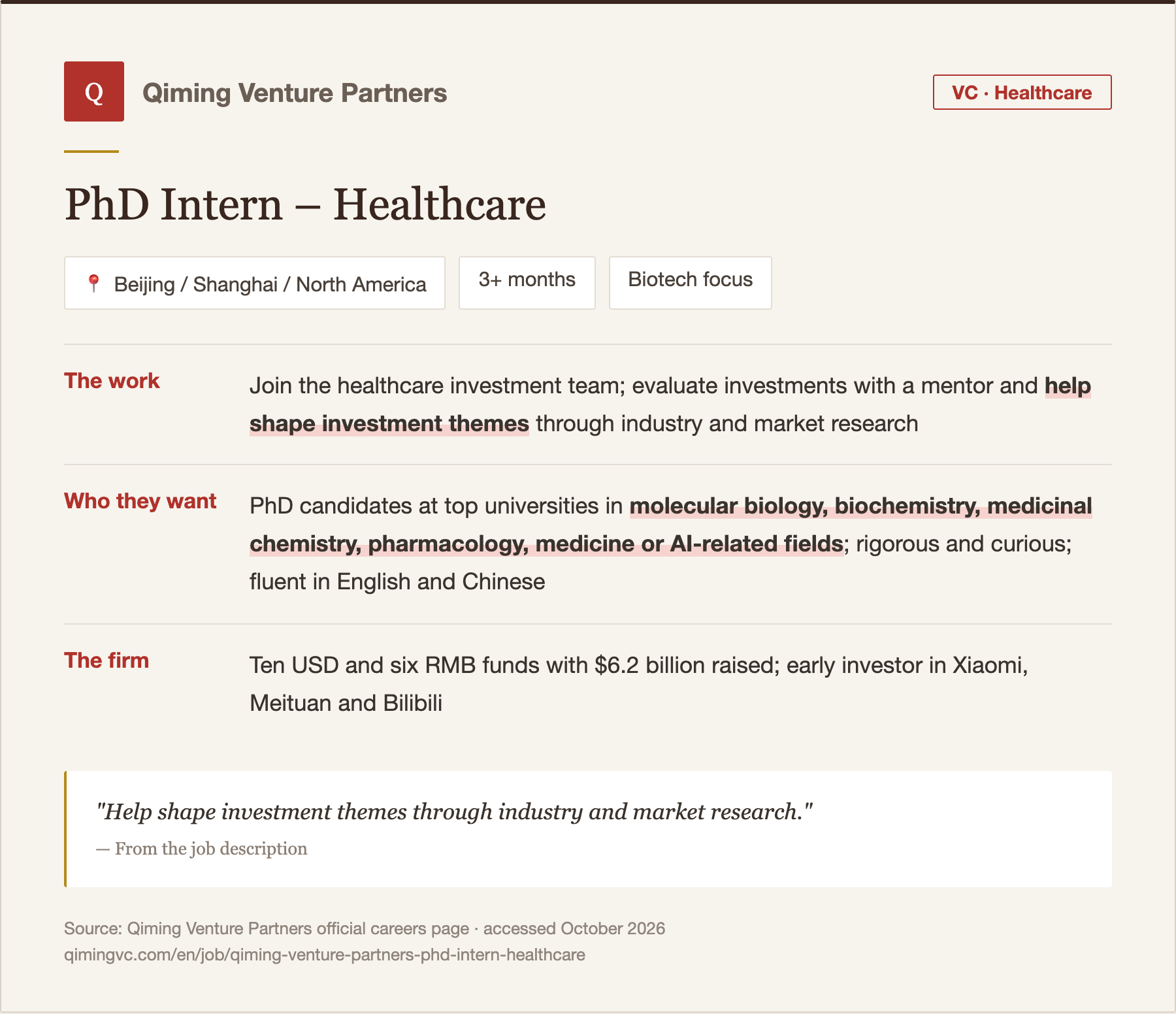
Same title, different job: this is the most overlooked thing about investment roles. Take three postings. At Battery Ventures, summer investment interns focus primarily on the firm's buyout strategy, alongside market and product analysis and sourcing new opportunities, and the job description specifically asks for an outgoing, sales-oriented personality comfortable in deep conversations with technology executives. At Blackstone in London, the Real Estate Acquisitions Analyst role centers on LBO models, valuation and deal execution. Qiming Venture Partners' healthcare PhD internship asks for PhD candidates in molecular biology, pharmacology, AI and related fields to help shape biotech investment themes.
Swipe or scroll to view more →
In North America, one skill matters enormously: deal sourcing. I've found that whether people here are extroverts or introverts, they all act like extroverts, because they have to build their own networks. The good news is that meeting investors in North America isn't hard. What sets people apart is turning those relationships into deal flow. China is the same: many fellow programs, such as those at MiraclePlus and ZhenFund, look for people who are good at finding people and companies.
Who's hiring: Battery Ventures 2027 Summer Investment Internship, StepStone 2027 VC Summer Analyst, Brevan Howard 2027 VC Summer Internship, Yunfeng Capital investment team intern, Yunqi Partners investment intern (strong performers may convert to analyst).
Best for people with solid financial fundamentals, industry judgment and a talent for building networks. Less suited to people who dislike reaching out or want clear daily processes.
2. Venture capital research jobs: markets, technology and investment theses
AI is compressing the value of basic information gathering and generic desk research. But researchers who understand both AI and a specific domain are increasingly in demand.
Day to day: researching industries, sectors and companies to form investment views. Some roles focus on more academic research, others on market research grounded in user needs.
Accountable for: depth of research and accuracy of judgment.
The role is splitting in two. On one side, AI is compressing the value of basic information gathering and generic desk research, while industry research, expert interviews and independent judgment still matter. On the other, if you have a product or STEM background, especially in quant, biology, materials or AI, research roles are very valuable. "AI for Science" is a hot area, and both Anthropic and OpenAI are pushing AI into scientific research. Many large firms are hiring for this: they have lots of deep tech companies heading toward IPOs and fundraises, and they want to make their own research workflows more AI-driven.
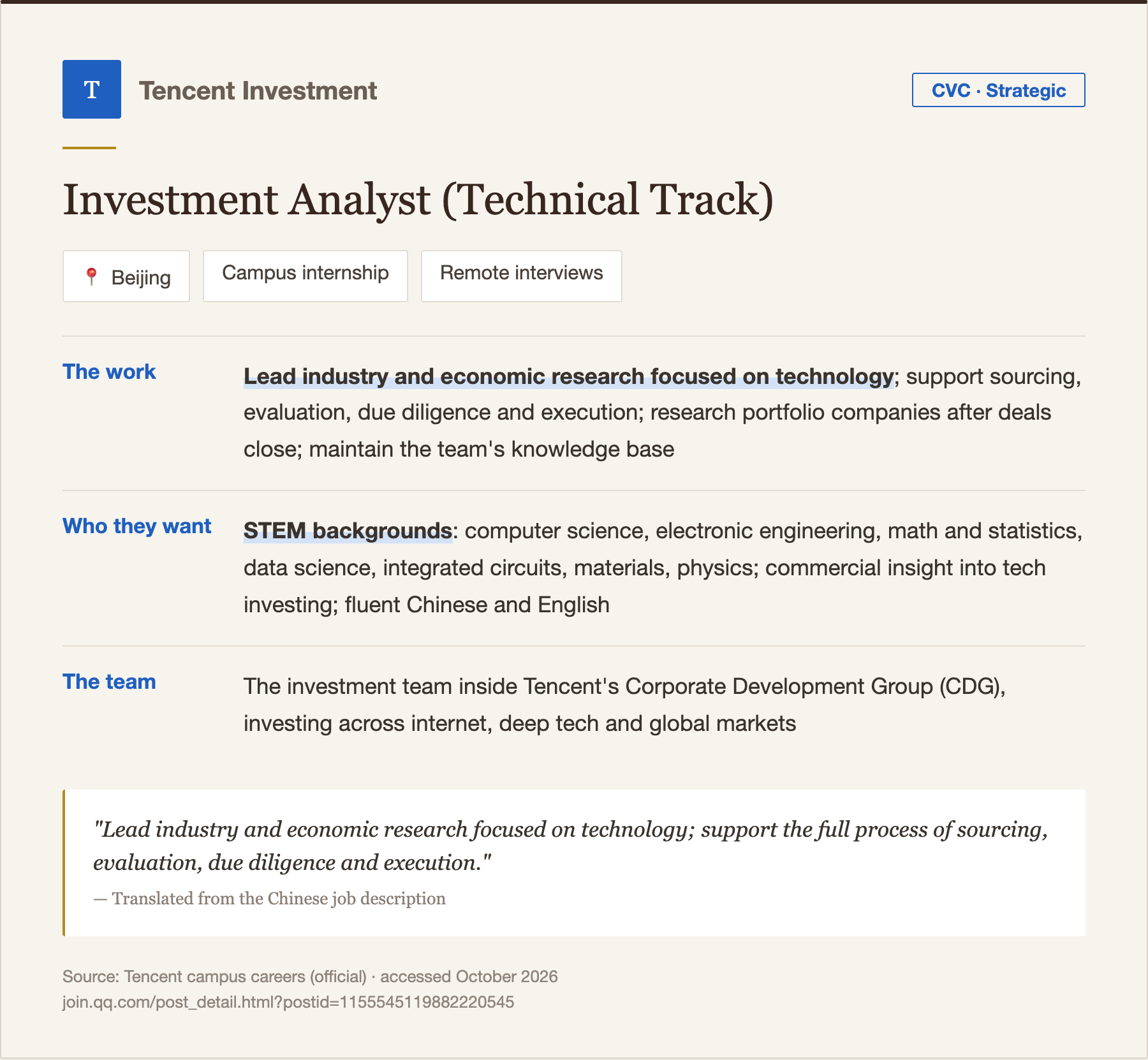
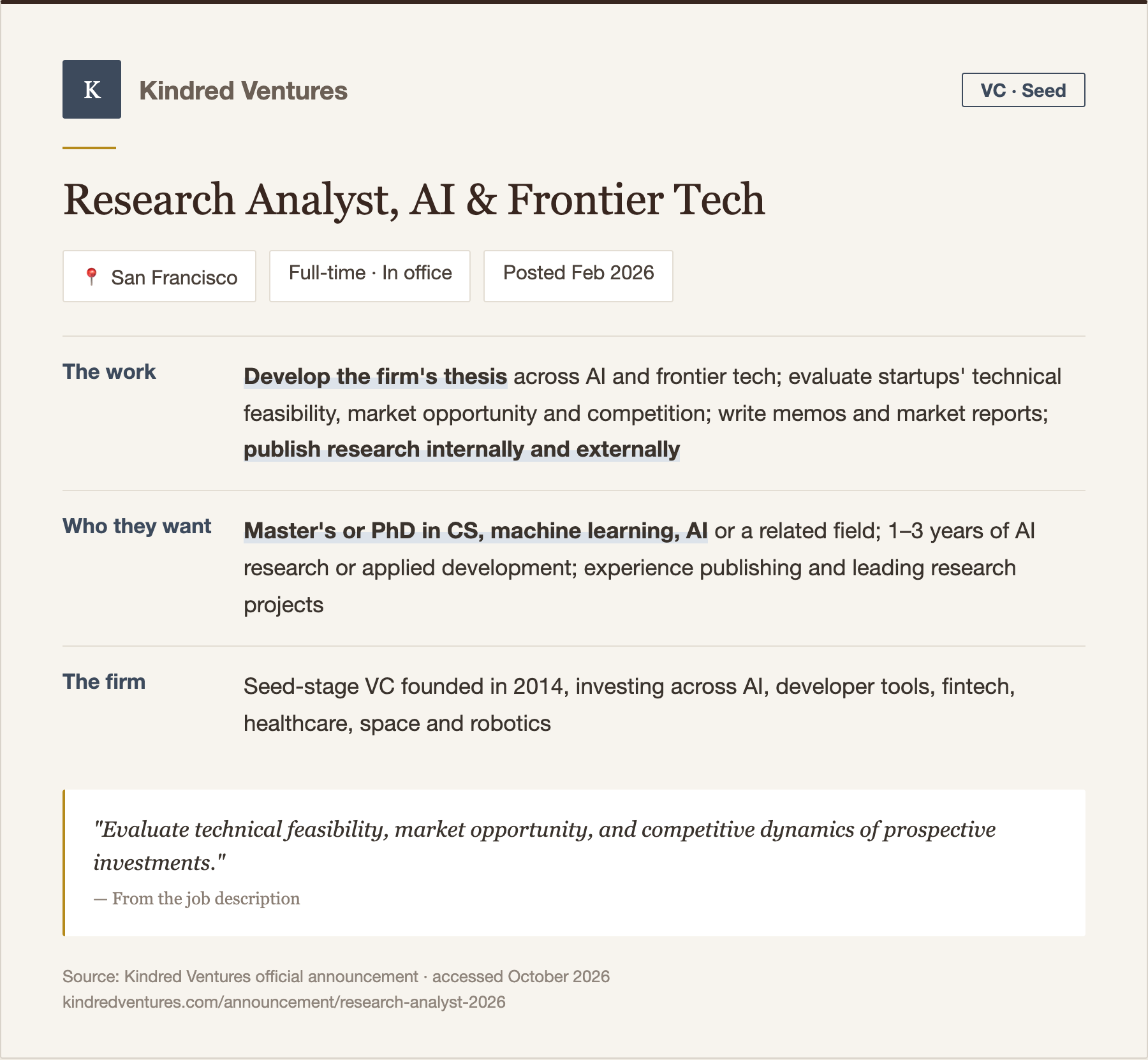
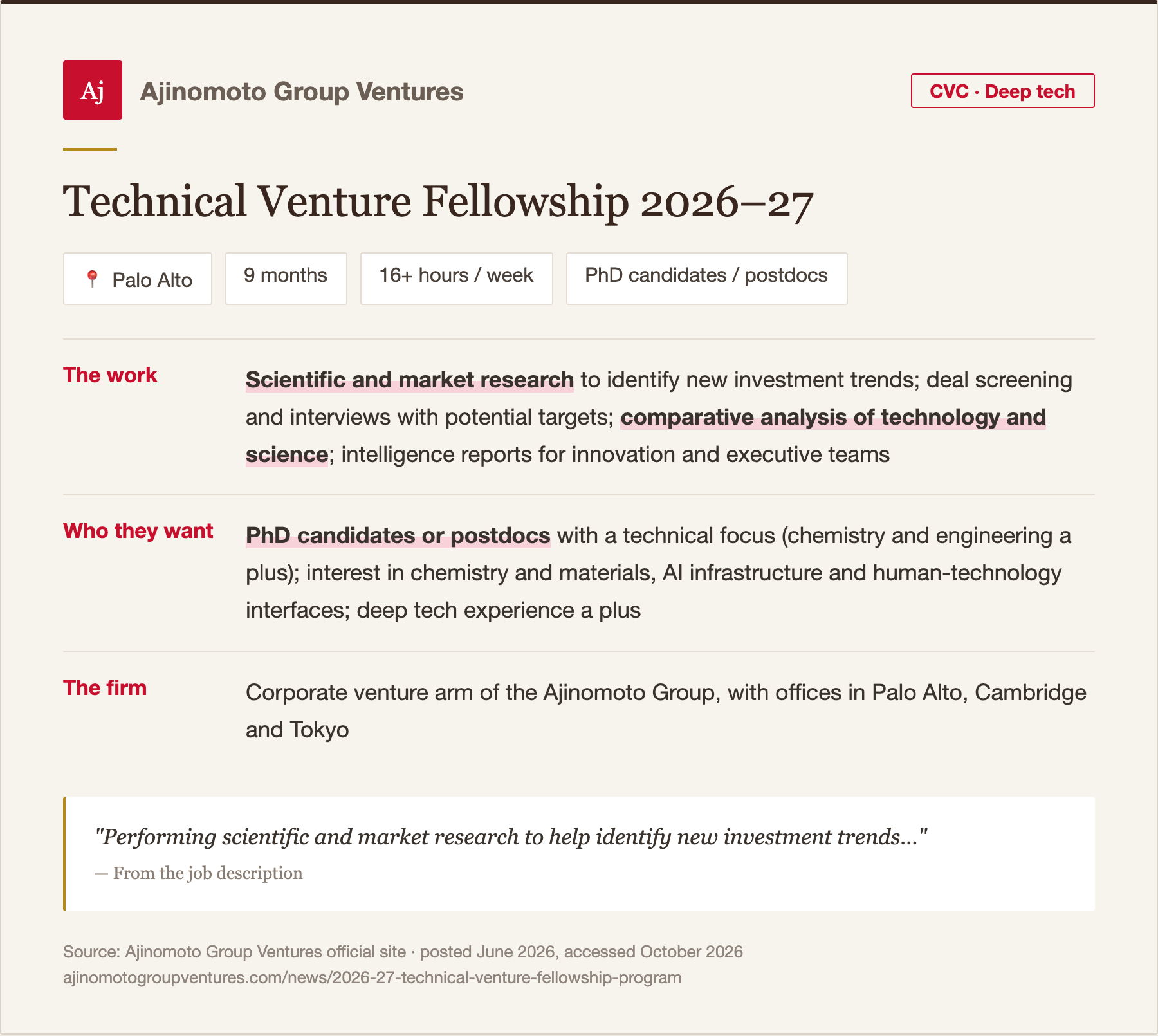
Who's hiring: Kindred Ventures Research Analyst, AI & Frontier Tech; Ajinomoto Group Ventures Technical Venture Fellowship (for PhD candidates and postdocs); Tencent Investment's Investment Analyst (technical track); Source Code Capital AI investment intern; V-Capital deep tech investment research intern (¥100–150/day); CICC 2027 Research Assistant.
Swipe or scroll to view more →
Best for STEM graduates, PhDs and people with product backgrounds who want to go deep in one field. Less suited to people who only want to write generic reports and don't plan to build expertise.
3. VC portfolio operations jobs: helping portfolio companies grow
Portfolio and startup support roles are plentiful in North America, and a direction many people never consider but fit well.
Day to day: helping portfolio companies recruit, build teams, drive growth and run operations; coordinating founders, in-house experts, customers and ecosystem partners; building programs and resources, tracking progress and reporting to stakeholders.
Accountable for: portfolio companies growing better, in other words, value creation.
Take a concrete example: the KKR Capstone MBA internship. The name sounds like management consulting, but the job description says it supports portfolio company managers or venture-building teams on recruiting, growth and operations, coordinates founders, internal experts, customers and ecosystem partners, builds programs and resources, and tracks progress for stakeholders. Why an MBA? Because the job requires hiring and managing people while also driving growth and operations, and MBAs know a little of everything.
These roles need multi-dimensional skills, a bit like an octopus keeping many things moving at once. a16z, Sequoia, KKR and J.P. Morgan all have plenty of them. Conversely, if your resume only says how many due diligence projects you did and how much money the deals involved, you won't get through for these roles.
Who's hiring: KKR Human Capital Summer Analyst ($35/hour), GE HealthCare Ventures internship, Blackstone Real Estate Asset Management Analyst in London, TowerBrook off-cycle Portfolio Group internship, Lighthouse Capital 3i incubation internship.
Best for people who have done partnerships, recruiting or operations at Fortune 500 companies, consultancies or tech companies, and MBAs. Less suited to people who only want to focus on investment judgment and dislike coordinating stakeholders.
4. Investor relations in venture capital: fundraising and LP relations
Investor relations is one of the directions I'm most optimistic about, and I have hired for a great many IR roles myself.
Day to day: preparing materials that explain investment strategy and performance to investors; managing institutional and wealth clients; organizing meetings, preparing reports and following up; running events and investor education.
Accountable for: the size of fundraises, client satisfaction and long-term trust.
Compare two postings. Tencent Investment's investor relations role involves preparing materials that explain investment products, strategy and performance, supporting relationships with investors, institutional clients and wealth clients, and handling reports, meetings and follow-ups. Picture it this way: a Tencent executive needs to present this year's investment strategy to the board, and someone has to get the materials ready. At firms with a stronger asset management character, such as Blackstone, the wording shifts toward managing client relationships and supporting wealth channels and client teams.
Interviews for these roles share one trait: close attention to your professional presence and how it feels to talk to you. Not looks, but your energy, whether you are well put together, whether conversations with you feel easy, and how you handle a crisis. People with high-net-worth client experience have a clear advantage, and that skill transfers, which is why many people from trust companies later move into wealth management.
Who's hiring: Tencent Investment 2027 Investor Relations; V-Capital fundraising intern (partly remote); Linxin Investment IR intern; KKR 2027 full-time analyst, insurance client coverage ($100,000–$110,000 base); J.P. Morgan Private Bank full-time analyst in Hong Kong; Lazard Institutional Client Group internship in New York.
Best for strong communicators with high-net-worth or institutional client experience who are detail-oriented. Less suited to people who dislike working with people and want to focus purely on research.
5. Venture fund operations: finance, legal and compliance
Finance, legal and operations roles are the easiest to overlook, yet almost every type of employer needs them.
Day to day: fund accounting and reporting, compliance, legal work, investment operations and day-to-day management.
Accountable for: accurate, compliant and efficient fund operations.
These roles keep an organization running: every investment has to go through process, every quarter LPs need reports, and every transaction has to meet regulatory requirements. The bigger the fund, the more complex and specialized this work becomes. Tencent Investment, for example, has a dedicated Investment Operations Analyst role covering portfolio data, fund operations and investment process management. HKEX's Graduate Associate program works on the infrastructure behind IPOs and markets.
These roles vary widely: some lean toward corporate finance, some toward fund finance, others toward legal and compliance. If you have a finance, accounting or law background, this is the most direct way in. After a few years, you can move into investing or portfolio roles, because you understand the structure behind a deal better than most.
Who's hiring: Tencent Investment 2027 Investment Operations Analyst; J.P. Morgan Global Finance & Business Management full-time in London; Barclays operations analyst graduate program in Glasgow; HKEX 2027 Graduate Associate; OMERS Performance Reporting & Attribution student role in Toronto; Carta finance and equity analysis rotational program.
Best for people from finance, accounting or law who are meticulous and like process and rules. Less suited to people who want a fast pace, high uncertainty, and investment decisions as soon as possible.
6. Product, data and technology jobs at venture and financial firms
If you have a technical background, product, data and technology roles at financial institutions are a strong option many people never seriously consider.
Day to day: building data, software, products and AI tools for investment teams, or working as an engineer at a portfolio company on real product iterations.
Accountable for: tools and systems that genuinely improve investment and operating efficiency.
There are two kinds. One is in-house, on technology teams at firms like Blackstone, BlackRock and KKR, building internal software, databases and AI tools. In London, we've seen people with technical and AI backgrounds land AI-related roles at J.P. Morgan with very solid pay. The other is at portfolio companies, such as Kleiner Perkins' KP Fellows program, where fellows work as engineers or designers at KP portfolio companies, building and shipping real product features.
Compared with many Big Tech roles, these have a very practical advantage: a more manageable pace. Many large tech companies in North America are under heavy pressure. A friend at a food delivery platform told me their KPIs are now tracked daily. Technology roles at financial institutions pay well, with a more predictable rhythm. If you've done product at a tech company and understand some financial workflows, moving into product at a financial institution often comes with a higher level.
Who's hiring: KP Engineering and Design Fellows; Blackstone full-time Software Engineering Analyst in London; J.P. Morgan full-time Data & AI analyst in London; KKR AI & Data graduate program in Dublin; Samsung Next remote technical fellowship ($45–$60/hour); LSEG Associate Product Manager in London.
Best for people with CS, data or engineering backgrounds, or product experience at tech companies. Less suited to people who have no interest in the financial side and want pure technology work.
7. Marketing and community roles at venture and financial firms
Many marketing students never realize they can do marketing at a financial institution. And marketing there is nothing like marketing elsewhere.
Day to day: brand, content and event planning; running founder and investor communities; analyzing audiences, channels and campaign performance.
Accountable for: brand impact, event quality and community engagement.
Take J.P. Morgan's Marketing Leadership Development Program: participants work across brand, digital and product marketing, analyze audiences, channels and campaign performance, and learn a large institution's full marketing process. At a financial institution, you might organize finance forums and summits for hundreds or thousands of people, inviting the industry's most influential investors and executives. Many North American startups now love pop-up events. At a financial institution, the same idea comes with higher-end venues and more important guests.
These roles have another advantage: they place almost no limits on academic background. Humanities, media and marketing majors, or anyone who has run communities and large events, can give it a try. For marketers who want to work inside professional-services and institutional brands, marketing at a financial institution is an often-overlooked direction.
Who's hiring: J.P. Morgan Marketing Leadership Development Program (summer and full-time); BNY marketing internship ($52,000–$80,000 annualized); Lazard Asset Management Sales & Marketing internship in London; Fidelity International sales and marketing internship; Perseverance Asset Management brand marketing intern (¥300/day, remote-friendly); China Europe Asset Management product and marketing intern.
Best for people from humanities, media or marketing, or who have run communities and events and have a feel for content. Less suited to people who dislike external communication or have no interest in brand and content.
Write your answer to the exercise before moving on. A plan only counts once it becomes evidence.