IN THIS CHAPTER
- 1. Capital owners: family offices, sovereign funds, endowments and pensions
- 2. Asset management careers: investment, private markets and client roles
- 3. Venture capital firms: investing in startups
- 4. Corporate venture capital: how CVC careers differ from VC
- 5. Private equity and growth equity: analysis and deal execution
- 6. Accelerators and venture studios: portfolio and founder support
- 7. Investment banking: advisory, capital raising and exit roles
- 8. Ecosystem services: exchanges, data, fund platforms and media
- 9. Compare all 8 venture employer types: pay, intensity, entry difficulty and fit
We'll move in the order of the capital cycle, from the source of the money to the exit.
1. Capital owners: family offices, sovereign funds, endowments and pensions
Ask students who want to break into venture where they most want to work, and most will say Sequoia, KKR or Blackstone. Very few say Temasek, the Yale Investments Office or a family office. Yet these sit at the very top of the chain. A large share of the money Sequoia and KKR manage comes from them, and every fundraising season, GPs from around the world fly in to pitch them.
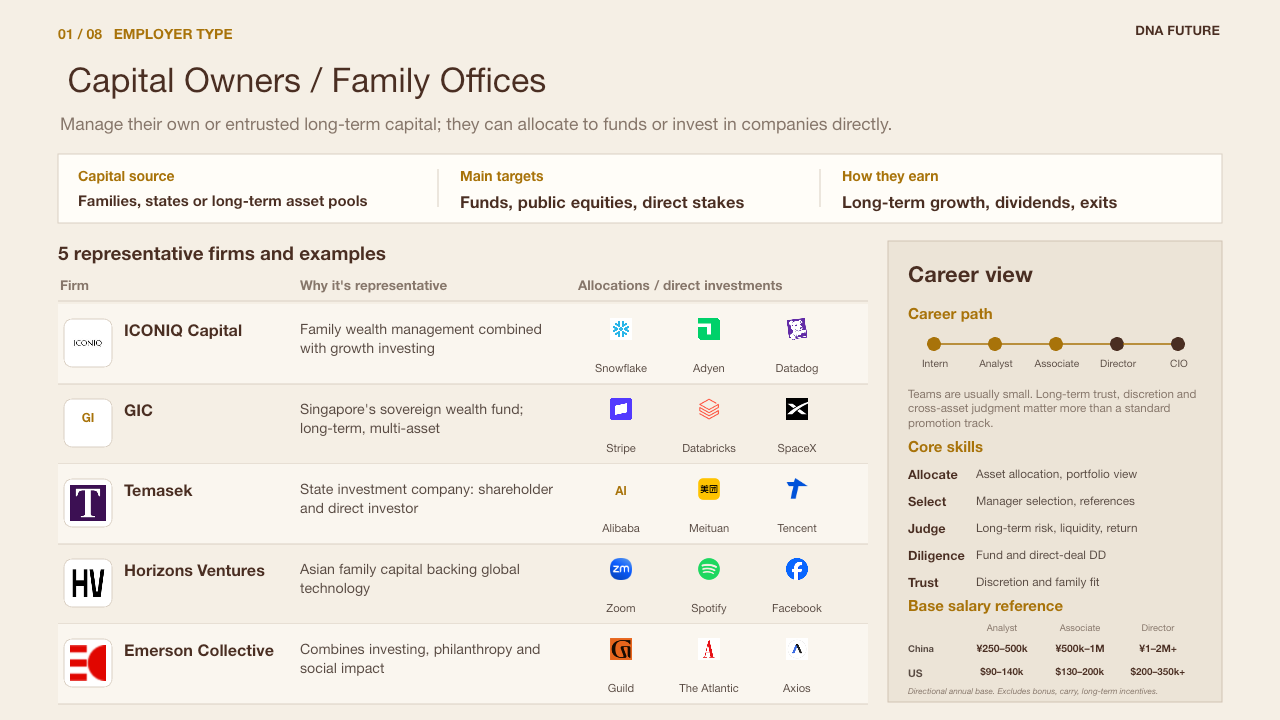
They are underrated because they barely recruit on campus, their teams are small, they hire only a handful of people a year, and their names sound more like "stability" than "investing." But on the LP side, you see how hundreds or thousands of funds raise money and get selected. That vantage point is hard to get inside any single GP. Four kinds of capital owners are worth special attention.
Family offices: it's not only about financial skill. A family office manages the wealth and affairs of one family, while a multi-family office serves several. Hong Kong's Blue Pool Capital is the family office of Alibaba co-founder Joe Tsai and one of the best-known Asian family investment platforms in public reporting. In North America, I've come across a number of family offices set up jointly by semiconductor families, some managing billions of dollars. Because a single-family office effectively serves one principal client, it values discretion, emotional intelligence and judgment alongside financial ability. In Palo Alto, I see this up close: senior MDs from investment banks and private banks regularly visit ultra-high-net-worth families to walk them through the year's investment strategy, and some even choose to live near their clients to stay close. These families and their offices are exactly who financial institutions compete to serve.
Sovereign and state-backed investors: platforms that preserve future options. Norges Bank Investment Management (NBIM) manages more than $2 trillion and is widely regarded as the world's largest sovereign wealth fund. Temasek reported a net portfolio value of S$518 billion as of 31 March 2026. Others include Singapore's GIC, the Abu Dhabi Investment Authority (ADIA), Saudi Arabia's PIF and China Investment Corporation. Hong Kong Investment Corporation (HKIC) is better described as a government-owned strategic investment company than a conventional sovereign wealth fund. The pay isn't always the highest, but experience at these institutions can preserve broad options across asset owners, funds and investment firms. HKIC also runs a paid winter internship programme (HK$11,800 a month in the 2026 round).
Insurance capital: the underrated "hard currency" on a resume. Insurers collect premiums before they pay claims, which makes them major long-term investors in bonds, private credit and private-market funds. In the US, the convergence of insurance and private markets has been striking: Apollo merged with Athene, and KKR fully acquired Global Atlantic. When I screen resumes for clients, I pay special attention to insurance investment internships. They can signal exposure to asset allocation, liability-aware investing and institutional capital. Client-facing insurance roles are different and should be evaluated separately.
University endowments and pension funds: the big money behind US venture. Harvard's endowment is about $56.9 billion and Yale's about $44.1 billion (both fiscal 2025). The "Yale model," with its heavy allocation to PE and VC, shaped a generation of institutional investors. CalPERS manages about $637 billion (June 2026). In Canada, CPP Investments (about C$793 billion, March 2026), the Ontario Teachers' Pension Plan (OTPP) and OMERS have built in-house teams that invest directly. North America has a lot of these institutions, which makes them a distinctive opportunity for international students. Examples include the Investment Analyst role at OTPP's Teachers' Venture Growth and the OMERS Real Estate Investments internship in London.
Best for people who value the long term and like seeing the whole picture. Less suited to people who want to be doing deals every day at a fast pace.
2. Asset management careers: investment, private markets and client roles
Asset management is, in my view, one of the best-value entry points: stable pay, mature training programs and a far wider range of roles than investment firms offer.
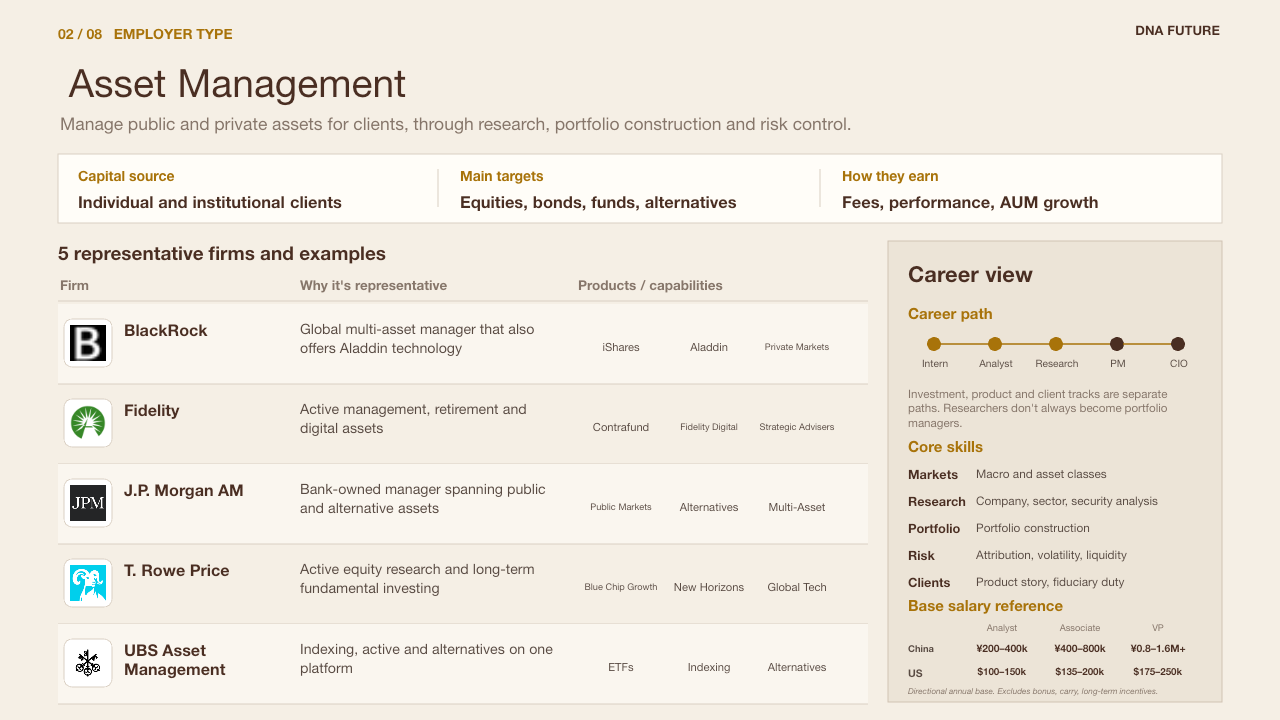
Asset managers invest on behalf of clients such as pension funds, insurers and high-net-worth individuals. BlackRock is the world's largest asset manager, with about $13.9 trillion in assets under management as of 31 March 2026. Others include Fidelity, J.P. Morgan Asset Management, UBS, Schroders and Point72.
Their revenue comes mainly from management fees charged on assets, so two things matter most: investment performance and client relationships. That's why, beyond investment research and quant roles, asset managers hire many people in sales, client relationships, product and marketing. Published base-salary ranges for entry-level analyst roles at large New York asset managers often sit around $80,000–$120,000, but total compensation varies substantially by function, firm, performance and seniority. Compared with small VC funds, large asset managers generally offer more structured pay and bonus systems.
Some large asset managers also invest directly or through dedicated private-market teams. Goldman Sachs Asset Management had been an LP in Industry Ventures funds for more than 20 years before Goldman Sachs completed its acquisition of Industry Ventures in January 2026. J.P. Morgan Asset Management runs Growth Equity Partners, which focuses on growth-stage technology companies, and Manulife Investment Management has a dedicated VC team. Join the right private-markets or growth-investing team and you can work on transactions directly.
Examples observed in the 2026–27 recruiting cycle included the Schroders Product Internship in London (£37,000 annualized, pro-rated for the internship length), Lazard's Asset Management Sales & Marketing internship in London, BNY's marketing internship in New York ($52,000–$80,000 annualized), and J.P. Morgan Asset Management's full-time investment analyst program in New York. Availability changes; verify each role on the employer's careers site.
Best for people who enjoy macro and asset allocation and value pay and stability. Less suited to people who want to work with founders every day and chase "zero to one."
3. Venture capital firms: investing in startups
For most people, VC is shorthand for this whole world. With small teams and few entry-level seats, it can also be among the hardest of the eight employer types to enter.
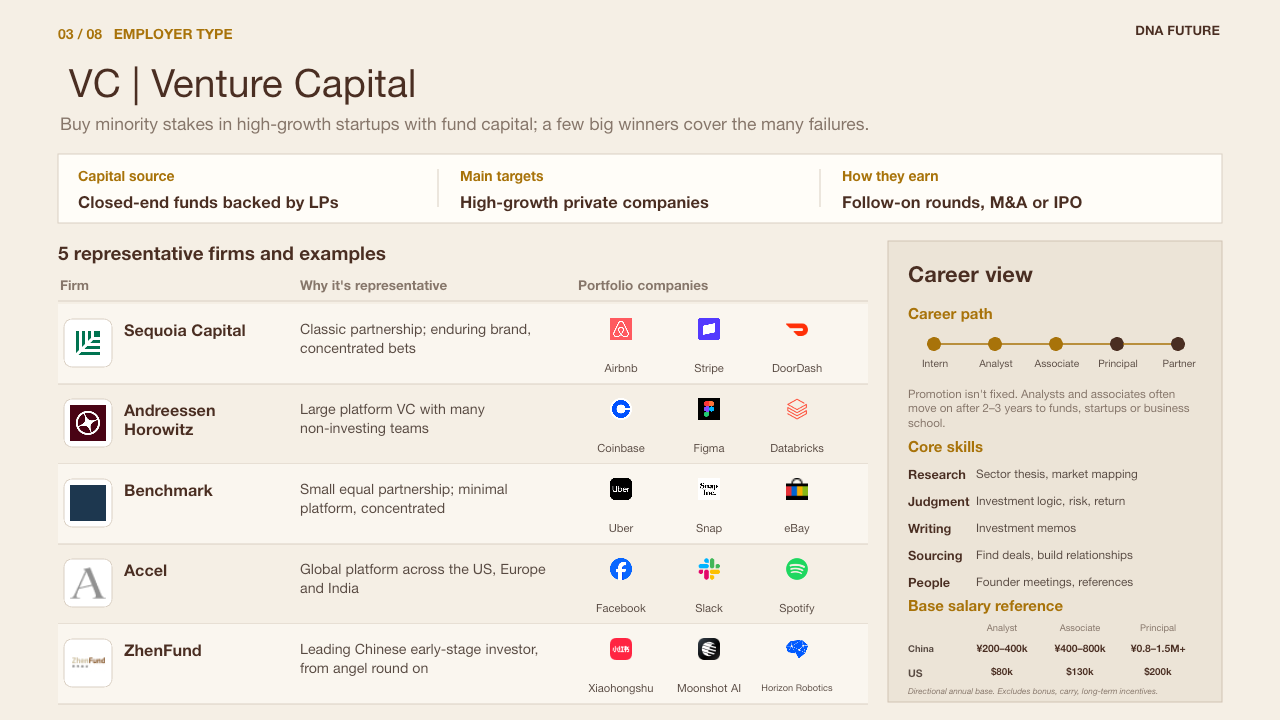
Venture capital firms invest LPs' money in startups, from seed to growth stage. Well-known global names include Sequoia, a16z (which states more than $100 billion under management as of April 2026; see our guide to the a16z ecosystem), Bessemer (about $20 billion), Battery Ventures and Kleiner Perkins. In China, they include Qiming Venture Partners, Source Code Capital, ZhenFund, Yunfeng Capital and Yunqi Partners. (For China's largest VC platform, see our guide to the HongShan ecosystem.)
VC firms earn management fees and carried interest ("carry," a share of investment profits). Management fees are usually a percentage of fund size, so pay varies enormously between firms. A small fund with tens of millions of dollars runs a lean team and may pay modest base salaries; a multibillion-dollar platform can pay analysts on par with investment banks. Published North American analyst roles often list base salaries around $100,000–$150,000—Bessemer's full-time Analyst base was $115,000 in the posting reviewed for this guide—but title, location, fund size and carry eligibility matter. The largest differences appear at senior levels, where carry can become a significant part of compensation.
For young people, VC offers something hard to replace: you see where industries are heading earlier than almost anyone. Where money is flowing, how technology is shifting, where the bottlenecks are. You don't wait for the news, because you see it in the companies you meet every day. Around Palo Alto and Sand Hill Road, investors and founders meeting over coffee to talk shop is completely routine. Few industries put you that close to the front line.
The price is the learning curve: AI today, semiconductors and quantum computing tomorrow. The founders, specialists and co-investors across the table may be domain experts themselves. An outsider can shrug at quantum computing or fusion, but for investors focused on those sectors, understanding the fundamentals is the baseline. I have a friend who spent late nights drinking wine and crying while relearning physics. It sounds romantic. In reality, it was painful.
As AI and deep tech have expanded, many VC roles increasingly favor three kinds of evidence: technical depth, demonstrated use of AI products and the ability to source promising companies. Job descriptions make this visible. Source Code Capital's AI investment role asks for people who "love AI and have their own research and hands-on exploration of AI products," and Qiming's healthcare internship recruits PhDs directly.
Best for people with lasting curiosity about industries, who enjoy working with founders and can sustain intense learning. Less suited to people who want high pay in their first few years or dislike uncertainty.
4. Corporate venture capital: how CVC careers differ from VC
If you already have an internship or full-time experience at a technology company, CVC may be the smoothest way to turn industry experience into investment experience.
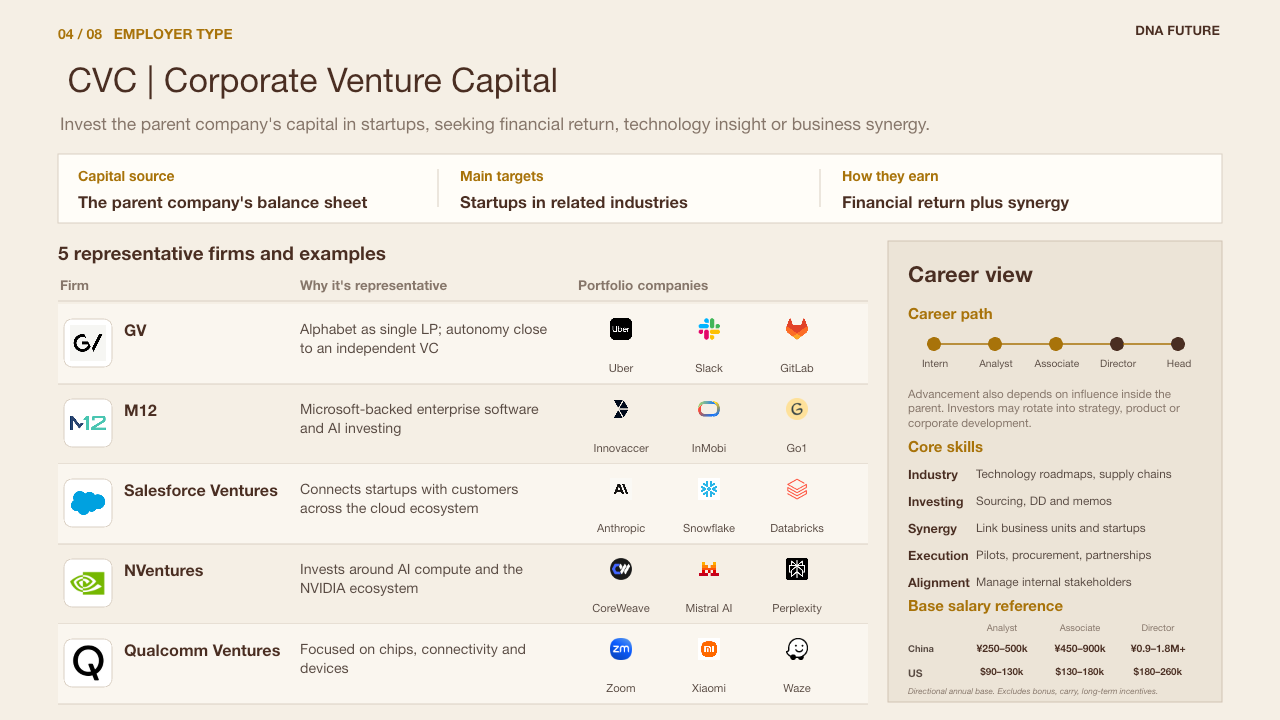
Corporate venture capital typically invests capital supplied by a parent company. Examples include Tencent Investment, Alibaba's strategic investment arm, GV (founded in 2009 and funded by Alphabet, but investing with relative independence), NVIDIA's NVentures, Intel Capital, Microsoft's M12, Samsung Next and Salesforce Ventures, as well as Micron Ventures, Robinhood Ventures and GE HealthCare Ventures.
Because the money usually comes from the parent, a strategic CVC asks not only "will this company make money?" but also "does it fit our business?" NVIDIA's investments are closely connected to its ecosystem, while Tencent Investment may consider potential links with businesses such as gaming, cloud or WeChat. Some CVC roles therefore overlap with corporate strategy, and interviews often ask concrete business questions: if you were the parent company, would you invest in or acquire this business? Which business line could it strengthen?
In campus-hire roles, CVC compensation can trail the best-funded independent VC platforms, although it varies widely by parent company and geography. Investment priorities may also be shaped by corporate strategy. But CVC teams sit inside an industry, understand its supply chain, and often have a pace and culture closer to a technology company. When I talk with people at GV and other corporate-backed investment teams, I notice many of them are heavy AI users who build things themselves. For them, investment judgment and product sense are connected.
Examples observed in the 2026–27 recruiting cycle included Tencent Investment's Investment Analyst, Investor Relations and Investment Operations Analyst roles, Robinhood Ventures' MBA investment internship ($47/hour), Micron Ventures' internship ($40.62–$55/hour) and Samsung Next's remote technical fellowship.
Best for people who know an industry well (cloud, semiconductors, healthcare) and come from tech companies. Less suited to people chasing large carry or wanting fully independent investment decisions.
5. Private equity and growth equity: analysis and deal execution
PE offers some of the most competitive pay among the eight, but it looks for very different people than VC does.
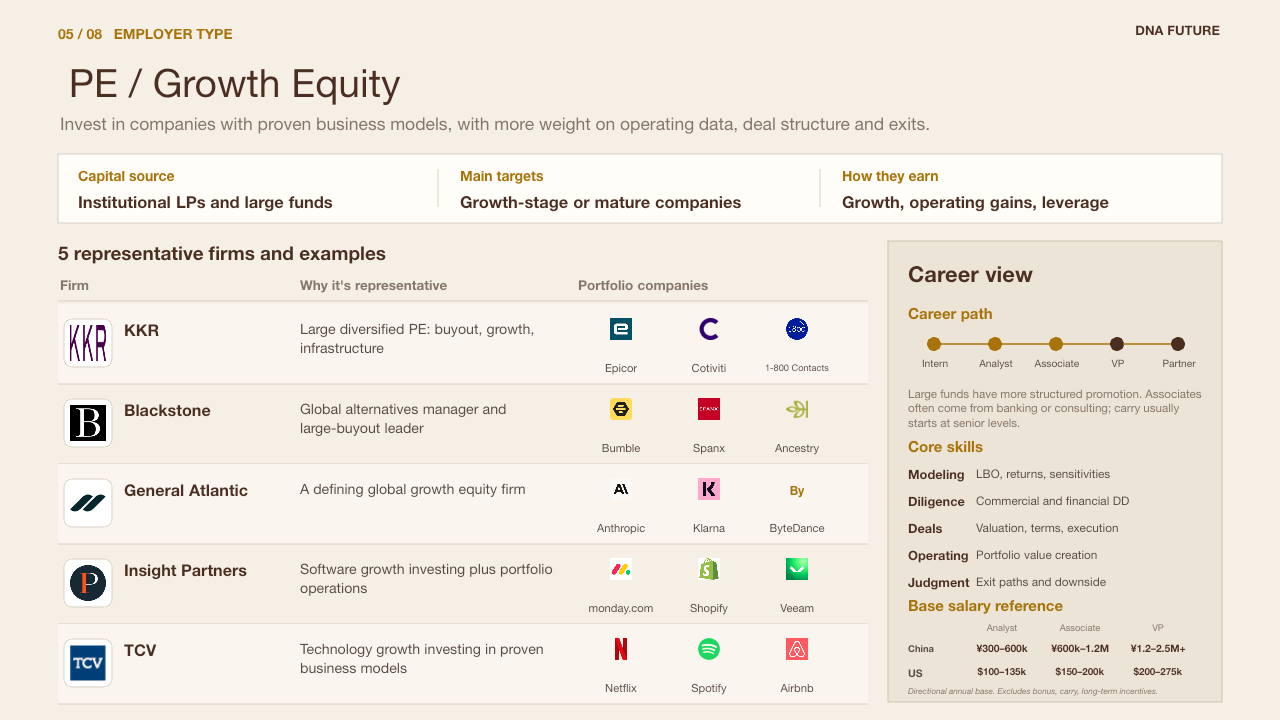
Private equity invests in mature or growth-stage companies through strategies such as growth equity and buyouts. Many of the same alternative-asset managers also operate private-credit businesses, but private credit is a separate asset class. Blackstone is the world's largest alternative asset manager, with about $1.35 trillion under management (Q2 2026). KKR managed about $744 billion at the end of 2025. Others include Bain Capital and General Atlantic (about $126 billion). In China, firms such as CICC Capital participate in private-market investing, while securities firms often advise on M&A and other transactions.
The two require different kinds of judgment. Early-stage VC often has to assess a team, a market and a technology with very little information, which takes a feel for users and products: will people love this pair of leggings, this new app? PE invests in companies with years of operating history, so judgment relies more on rigorous analysis. LBO modeling, valuation and term negotiation are the basics, because a single deal can run from hundreds of millions to billions of dollars, and one wrong assumption can be very costly.
On trips to Los Angeles and New York to meet PE investors, I found that US private equity is highly specialized. Firms focus on different sectors and deal sizes, and strategies differ completely from large-cap buyouts to the middle market. PE also offers a great path for people with management ability: you can move into portfolio companies as a board member or executive.
Examples observed in the 2026–27 recruiting cycle included Blackstone's Real Estate Acquisitions Analyst role in London, the KKR Capstone MBA internship ($170,000–$175,000 annualized), KKR's Human Capital summer analyst role, and Bain Capital's Investors of Tomorrow program for sophomores.
Best for people with rigorous analytical thinking, strong financial fundamentals and management potential. Less suited to people who prefer relying primarily on intuition and personal judgment, or who dislike modeling.
6. Accelerators and venture studios: portfolio and founder support
If you want to start a company one day, accelerators and venture studios can be among the most direct training grounds.
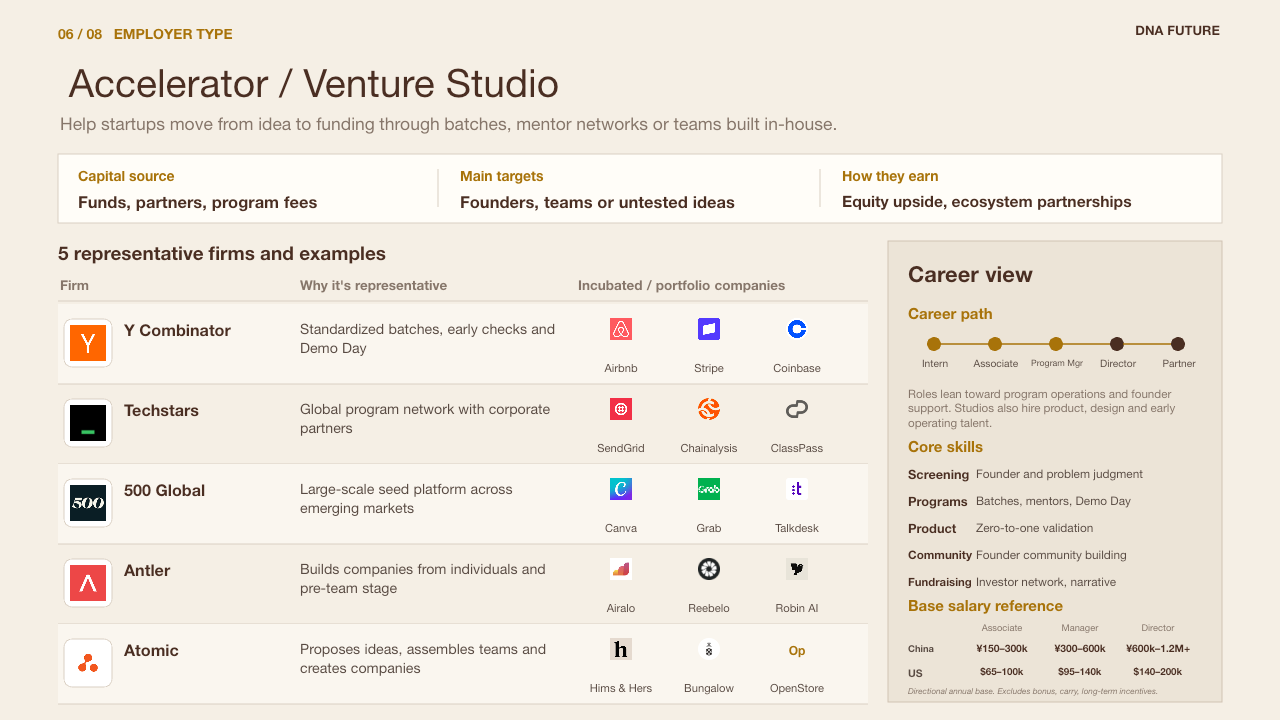
An accelerator invests a small amount in very early teams, then helps them grow fast through programming, mentors and investor networks. A venture studio goes further, building companies with founders from the idea stage. Y Combinator is the best-known accelerator, having invested in more than 5,000 companies, with a standard investment of $500,000. In China, there is MiraclePlus, founded by Qi Lu. Globally, there are also 500 Global, Plug and Play, Expa, Founders Factory and Lighthouse Capital's 3i incubation program.
Equity-based accelerators build portfolios by taking small stakes in many early companies, while other programs may also rely on sponsorships or fees. They need people who aren't only "deal-picking experts," but who can push many teams forward at once: running programs, matching mentors, preparing Demo Day and helping founders meet investors. YC's Demo Day, for example, introduces each batch to a large invited investor audience.
Here, you spend every day with founders and watch ideas become companies. It is rewarding, and your network grows fast. In the US, strong accelerators are often backed by very successful founders or investors. The trade-off is that pay is usually modest, and organizations vary widely in size and stability.
Examples observed in the 2026–27 recruiting cycle included Plug and Play's Ventures Associate, Expa's remote Research Associate ($80,000–$110,000), Founders Factory's Talent Investor in London, and Lighthouse Capital's 3i incubation internship in Shanghai (¥200/day including meal allowance).
Best for people with strong execution who love "zero to one" and want to found something. Less suited to people who prioritize high pay and stability or prefer clear processes.
7. Investment banking: advisory, capital raising and exit roles
Investment banking is one of the most established starting points for a career in venture and private markets.
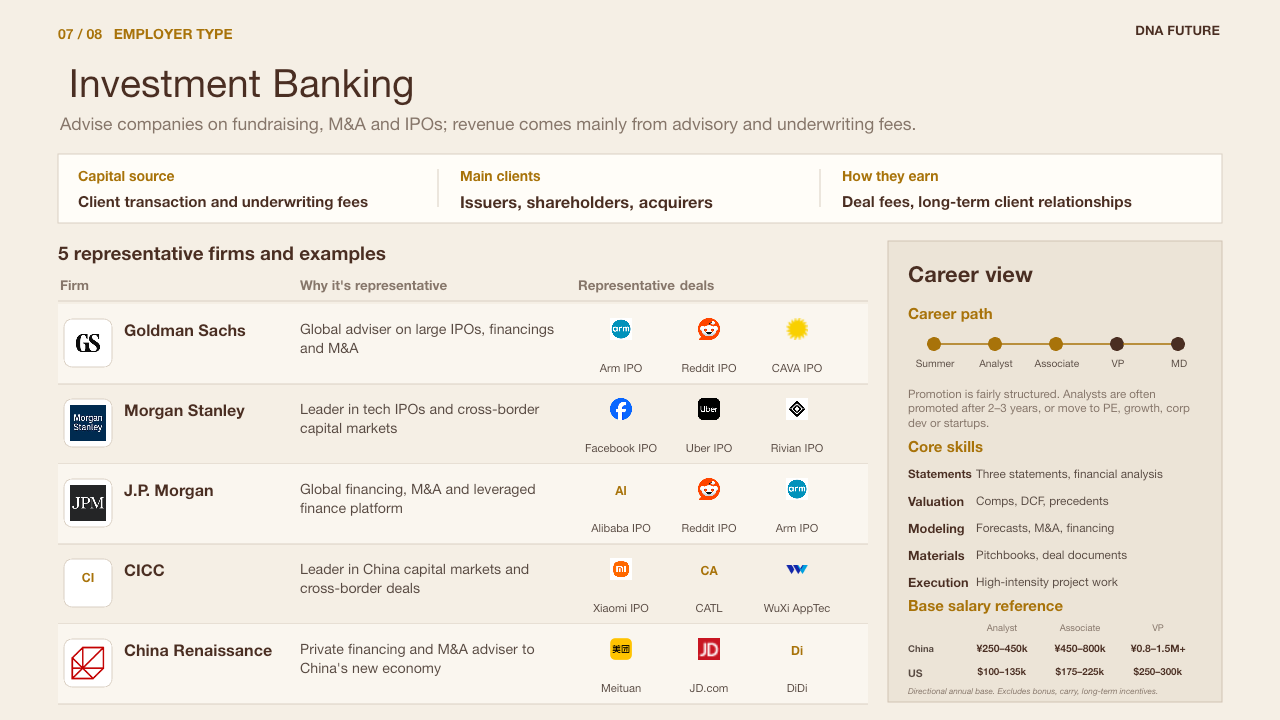
Investment-banking advisory teams primarily help clients go public, merge, acquire businesses and raise capital, earning fees on transactions. Large banking groups may also deploy their balance sheets through other divisions, so "investment bank" does not mean the institution never invests its own capital. Examples include J.P. Morgan, Goldman Sachs, Barclays and Lazard, and in China, CICC, CITIC Securities and Huatai Securities.
Because advisory revenue follows transactions, banking hiring moves with capital markets. For many Chinese companies seeking an offshore listing, Hong Kong has become a leading venue. HKEX ranked first globally for IPO fundraising in 2025, raising US$37.4 billion across 119 listings; new-economy sectors accounted for 66% of capital raised. I know a geography student from a UK G5 university who had no banking internship and no Big Tech background, but understood the mining-exploration industry. When a securities firm needed support on an exploration-related AI company preparing to list, that sector knowledge became directly relevant. Technical fluency and credible industry knowledge are becoming real advantages in banking.
Banks offer structured training and a widely recognized credential, and banking remains one of the most established springboards into PE and some VC roles. Published summer-internship pay at large London banks is often annualized at roughly £50,000–£65,000, while Hong Kong monthly pay varies substantially by bank and role. The cost is very long hours.
Examples observed in the 2026–27 recruiting cycle included J.P. Morgan's full-time Innovation Economy analyst role in London (covering high-growth and VC-backed companies), Barclays' graduate programs, Lazard's full-time M&A analyst role in London, and CICC's annual campus recruitment.
Best for people who can handle intensity, want strong financial and deal fundamentals, and have STEM backgrounds. Less suited to people who prioritize work-life balance or want to make investment decisions themselves long term.
8. Ecosystem services: exchanges, data, fund platforms and media
If you're not yet sure you want to make investment decisions, ecosystem services are an excellent vantage point.
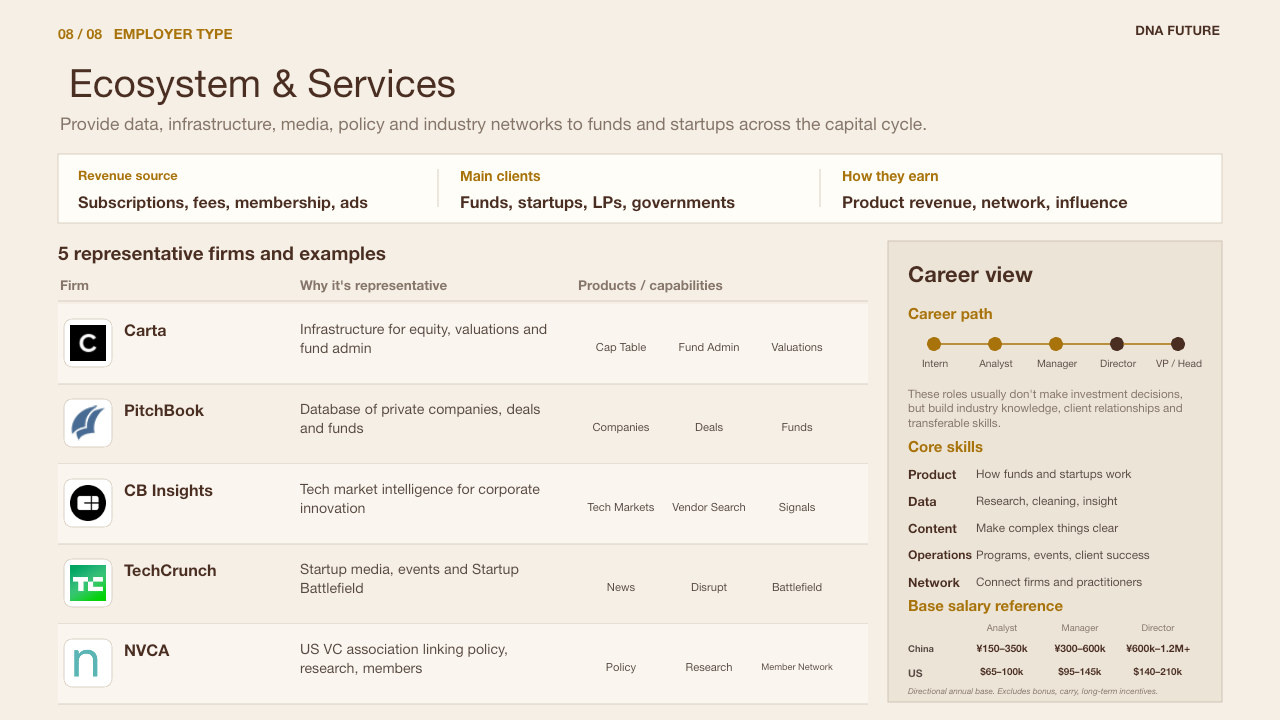
These organizations' primary business is not deploying capital. They provide infrastructure for the capital cycle: exchanges such as HKEX and LSEG; private-market databases such as PitchBook; equity and fund-management platforms such as Carta (supporting more than 10,000 funds and SPVs representing more than $250 billion in assets); venture media such as 36Kr, Jazzyear and The Information; and industry associations.
They earn money from transaction fees, data subscriptions, software and content, and their value lies in connection. Exchanges connect issuers and investors, databases organize information on funds and companies, and media connect the industry's attention. Working here can put you at an information hub. As a reporter at a venture publication, or as an employee at an exchange or data platform, you have a credible reason to reach out to leading investors and founders. We feel this ourselves when we host events in North America and co-host sessions with Google.
Pay in ecosystem services is usually not the highest. But the network and industry perspective you build early in your career are often what matter most when you later move to an investment firm.
Examples observed in the 2026–27 recruiting cycle included HKEX's Graduate Associate program, PitchBook's Portfolio Analyst, Private Capital ($70,000–$80,000), Carta's finance and equity analysis rotational program, and LSEG's Associate Product Manager role in London.
Best for people who want to understand the whole industry first, build a network, and enjoy data or content. Less suited to people who want investment decision rights and carry as soon as possible.
9. Compare all 8 venture employer types: pay, intensity, entry difficulty and fit
The ratings below are directional, not universal. Compensation, workload and hiring difficulty vary by firm, geography, seniority and market cycle. Recruiting examples and pay figures in this chapter were reviewed on 18 October 2026; always confirm that a posting is still live before applying.
| Employer | Where the money comes from | Pay (relative) | Intensity | Difficulty of entry | Best for |
|---|---|---|---|---|---|
| Capital owners | A family's, institution's or public pool of capital | Medium; lower at some government-linked institutions | Medium-low | High: few campus roles, often referral-driven | Long-term thinkers who like the big picture |
| Asset management | Clients' money | Medium-high; mature bonus structures | Medium | Medium: established campus programs | Macro and allocation lovers who value stability and pay |
| VC | LP commitments | Medium; long-term upside via carry | Medium-high; steep learning | Very high: fewest seats | The curious, who enjoy working with founders |
| CVC | Parent-company capital | Medium; varies by parent | Medium | Medium: sector or corporate experience helps | Industry experts from operating companies |
| PE / Growth | LP commitments | High | High | High: modeling and deal skills | Rigorous thinkers with strong finance and management potential |
| Accelerators / studios | Sponsor, balance-sheet or fund capital | Medium-low | Medium-high | Medium | Strong executors who want to found companies |
| Investment banking | Client advisory and transaction fees | High | Very high | Medium-high: many campus roles, fierce competition | People who can handle intensity and want transaction fundamentals |
| Ecosystem services | Service revenue | Medium | Medium | Medium-low | Network builders who want to see the whole industry first |
Now look at it another way: what you gain, and what you give up. Every choice trades some things for others.
| Employer | What you gain | What you give up |
|---|---|---|
| Capital owners | A view of how hundreds of funds get selected; long-term stability; the option to move to a GP or family office later | Deal pace and front-line exposure; few campus entry points; lower pay at some government-linked institutions |
| Asset management | Mature training; predictable pay and bonuses; many role options | Distance from founders and the "zero to one" experience |
| VC | Seeing industry shifts earlier than most; a founder network; potential long-term carry | Uncertain early pay; intense learning; very few seats |
| CVC | Industry perspective and Big Tech resources; a tech-company pace and culture | Independent decision-making and carry; direction shaped by the parent's strategy |
| PE / Growth | Rigorous modeling and deal training; competitive pay; a path into portfolio-company leadership | Work-life balance; exposure to early-stage innovation |
| Accelerators / studios | The closest seat to founders; a fast-growing network; a training ground before founding | Pay and stability |
| Investment banking | Complete training and a highly recognized resume; a springboard to PE and VC | Very long hours; no investment decisions |
| Ecosystem services | A position at the information hub; a view of the whole industry and its people | Investment decision rights and carry |
Three takeaways:
First, high pay usually comes with high intensity. In typical campus-hire roles, PE and investment banking usually pay the most and demand the most. Asset management is one of the few options with good pay and moderate intensity.
Second, difficulty of entry doesn't track fame. VC typically has fewer entry-level seats and can be among the hardest categories to enter. Capital owners are less visible, but can also be difficult because they recruit infrequently. Asset managers and banks, by contrast, often have established campus programs and therefore offer more predictable entry points.
Third, don't judge by your first job alone. Many people build fundamentals in banking or asset management first, then move to PE or VC. Others work in product at Big Tech before joining a CVC. Others learn how funds work on the LP side, then move to a GP or a family office. Your first job isn't just a choice of employer. It shapes which paths open up afterwards.
So, back to "where to go." Instead of asking "which firm is best," ask: "which position along this chain best fits my background today and the life I want?"
Write your answer to the exercise before moving on. A plan only counts once it becomes evidence.