IN THIS CHAPTER
Many students miss venture capital internships not because they are unqualified, but because they begin looking after the relevant recruiting window has already opened. The first application skill is timing.
When do venture capital internships open? The 2027 recruiting timeline
Recruiting in venture and private markets often starts much earlier than students expect:
| North America | United Kingdom | Mainland China | Hong Kong | |
|---|---|---|---|---|
| Summer internships | Often open 12–20 months ahead | Most open September–November; many review on a rolling basis | Mostly spring; off-cycle internships run year-round | Many open in autumn; off-cycle roles run year-round |
| Full-time / graduate roles | Large firms often convert summer interns | Graduate programs commonly open September–November | Autumn campus recruiting, usually September–October | Autumn campus recruiting plus referrals |
| Small funds | Hire year-round as needs appear | Year-round | Year-round | Year-round |
A few examples from the October 2026 recruiting cycle illustrate the timing:
- North America: Battery Ventures advertised a 2027 summer internship aimed at the class of 2028. Insight Partners planned to open its 2028 Summer Analyst program in late October 2026. Sophomores should start preparing now for the internship after junior year.
- United Kingdom: many summer programs at large banks and asset managers open between September and November and review applications as they arrive.
- Mainland China: large institutions recruit through autumn campus cycles, while VC off-cycle internships appear throughout the year and often require three or four days a week for at least three months.
- Hong Kong: large institutions combine autumn recruiting with winter and off-cycle programs.
Small VCs and family offices operate differently. They may have no fixed campus cycle, hire only when workload increases and fill roles through referrals. For them, relationships and information channels matter as much as the application date.
Treat all examples as snapshots, not permanent deadlines. Always verify the current opening on the employer's official careers page.
Where to find venture capital internships and entry-level jobs
There are three common places to find postings. But public postings are only one of five ways in, and each entry point needs different proof upfront:
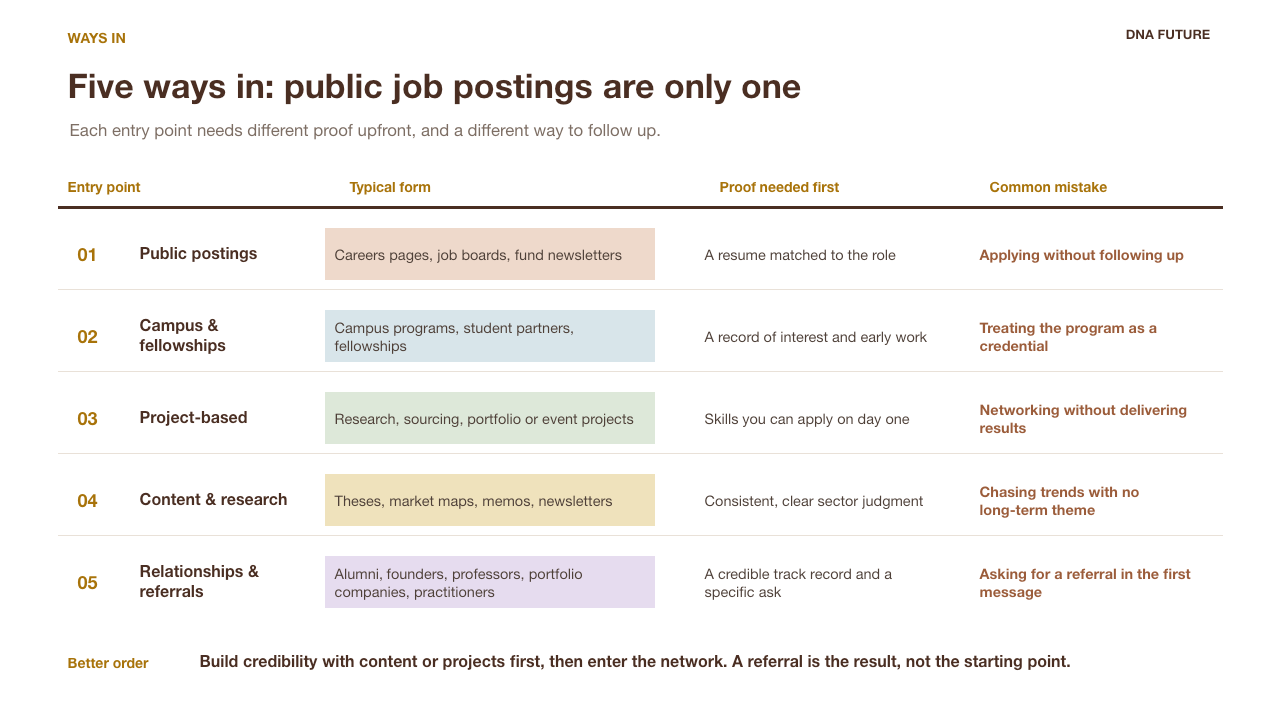
For postings themselves, use these three channels.
1. Official careers pages. This is the most reliable source. Large institutions commonly use systems such as Workday, Greenhouse and Ashby, and openings may close as soon as enough candidates enter the pipeline.
2. Campus programs and referrals. Many institutions work with universities and student organizations. Small VCs and family offices rely especially heavily on referrals because they hire infrequently and can't review thousands of applications.
3. Curated job lists. Venture Jobs 100 organizes roles across North America, the UK, mainland China and Hong Kong. Roles are tagged by employer type, function, hiring status, early-career fit, location and disclosed compensation.
If you are a first- or second-year student, look beyond roles called "VC Intern." Spring insight programs, student fellowships, scout programs, accelerator roles, research projects and portfolio-company work can all create the proof needed for a later investment role.
How to build a referral before you apply
Referrals don't appear out of nowhere. Build them in three steps.
Find the right person. Look for someone at the target firm who was in your position two or three years ago. A junior investor, analyst or program alumnus is often more likely to reply than a partner.
Keep the first message specific. Use one sentence to introduce yourself, one short paragraph about a deal, thesis or portfolio company relevant to the person, and one small request such as a 15-minute call.
Ask questions that reveal the work. Ask what the team does day to day, which sectors it is watching and what makes someone useful in the role. Don't open with "Can you refer me?" Send a thank-you note, then stay in touch by sharing relevant work.
Relationships accumulate. Many useful referrals begin with a piece of research or a founder introduction sent months before a role opens.
How to apply for a VC internship
Before submitting, be able to answer five questions:
- Why this employer type: VC, CVC, PE, family office, accelerator or another part of the ecosystem?
- Why this specific firm, stage and sector?
- Which function are you applying to perform?
- What proof shows you can already do part of that work?
- What will the firm gain from hiring you instead of another interested student?
Your next step isn't another generic application. It is a role-specific resume. Chapter 6 shows how to write one.
Write your answer to the exercise before moving on. A plan only counts once it becomes evidence.